ARTWORKS
THE STILLNESS
Katherine Hunter’s landscape paintings explored the relationship between memory, nature, and presence. Her work featured spaces in which she stood and spent time disconnecting from the digital world. From sleeping beneath the stars in the Kalahari Desert’s red sand, watching the sunset over the Atlantic coast, and being surrounded by the lushness of Kirstenbosch Gardens in Cape Town. Each space contained a cache of poignant personal memories and was represented on the canvas with certain dreamlike qualities that invited the viewer to guess at seen and unseen joys.
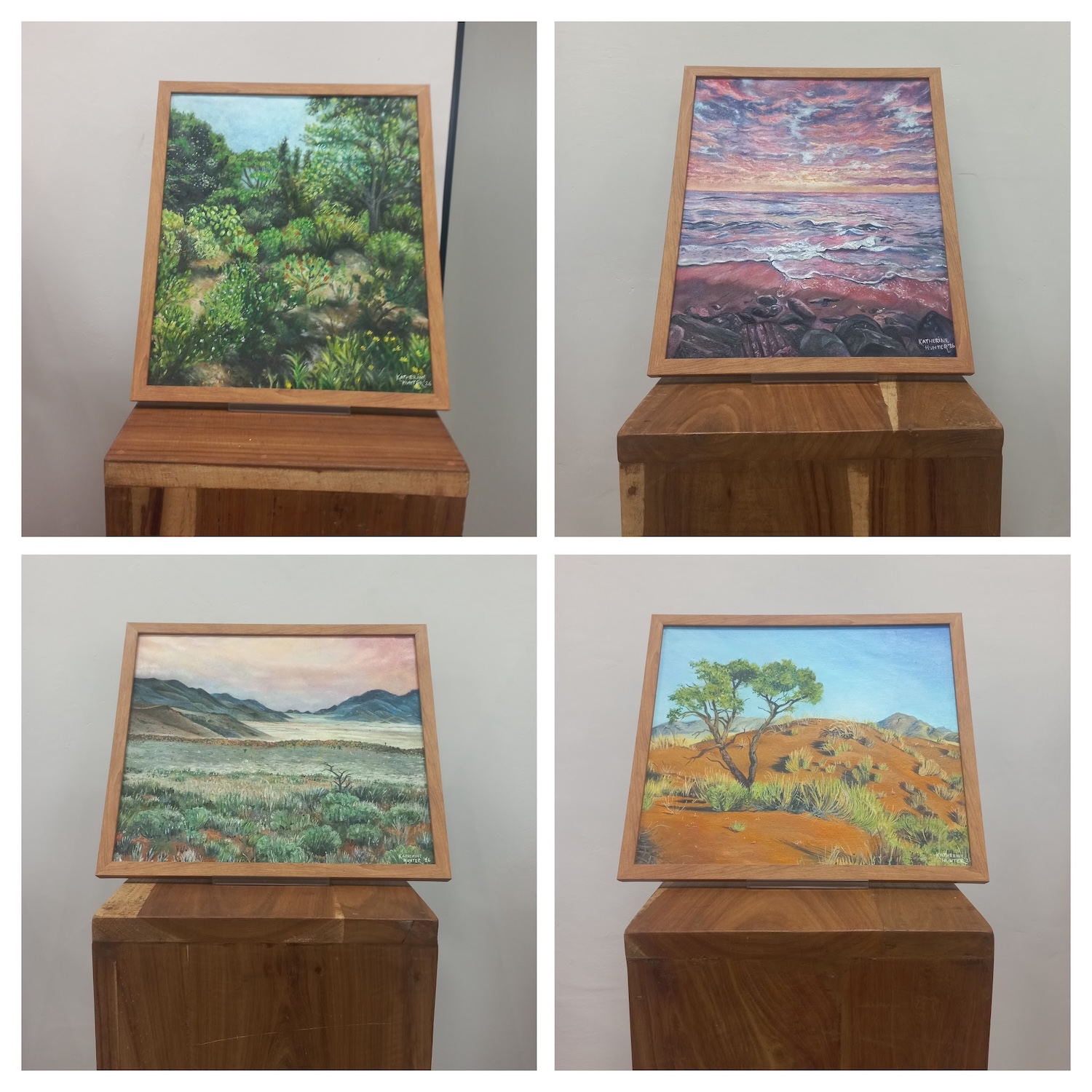
Four paintings were produced using oil paint on canvas and hand-stretched canvas on MDF board.
WINDHOEK IN BLUE


Using acrylic paint on stretched canvas, Amine Serhane completed an Arabic calligraphy painting using a mixture of scripts featuring symbols from all of the calligraphy workshop participants.
TAPESTRIES
Each tapestry began as a hand-drawn illustration, which was translated into full-scale paper patterns using standard paper and large-format plotter paper. The individual pattern pieces were cut, arranged, and assembled by hand before being transferred to fabric.
The works were constructed primarily through appliqué and hand-sewing techniques, with smaller details stitched individually. The artists pressed and sewed fabric edges and borders to create a finished structure, then added selected highlights by hand using acrylic paint.
Tapestry One: The Past Is Never Where One Leaves It
The past is always shifting—being buried from neglect and excavated with rediscovery, and being settled and then reinterpreted. It is never where one leaves it and never entirely left behind; it exerts quiet gravity on who we are, where we find ourselves, and how we make choices about the future. The past is active in the present and can be found in the things we remember, record, and retell.
Materials used were cotton, embroidery thread, faux leather, felt, mesh, organza, polyester satin, and sewing thread.
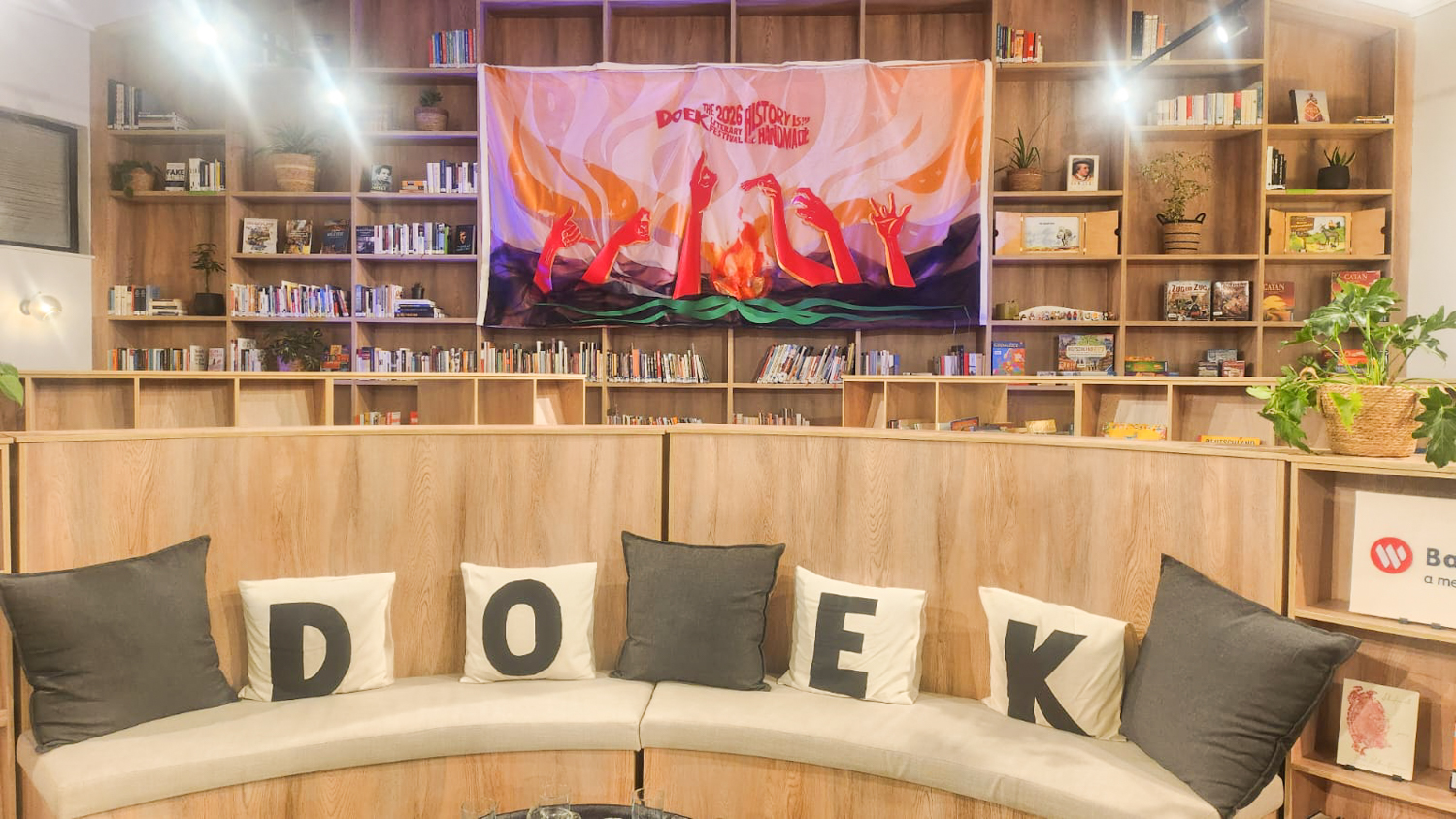
Tapestry Two: History Is Handmade
Human mark-making and written language fulfil many functions: transmitting a message about danger in an environment filled with numerous threats; recording the visual history of a bygone people; capturing the imaginative landscape of a writer; some of the oldest forms of communication; and collecting knowledge and wisdom from ancient or modern sources.
Across the composition, different forms of inscription, symbols, and handwriting sit alongside one another as evidence of our persistent need to communicate, document, and make meaning. The Cyrillic and Arabic calligraphy both translate to “handmade”.
Materials used were cotton, embroidery thread, faux leather, felt, mesh, polyester satin, and sewing thread.
Tapestry Three: The Present is Whatever You Make It
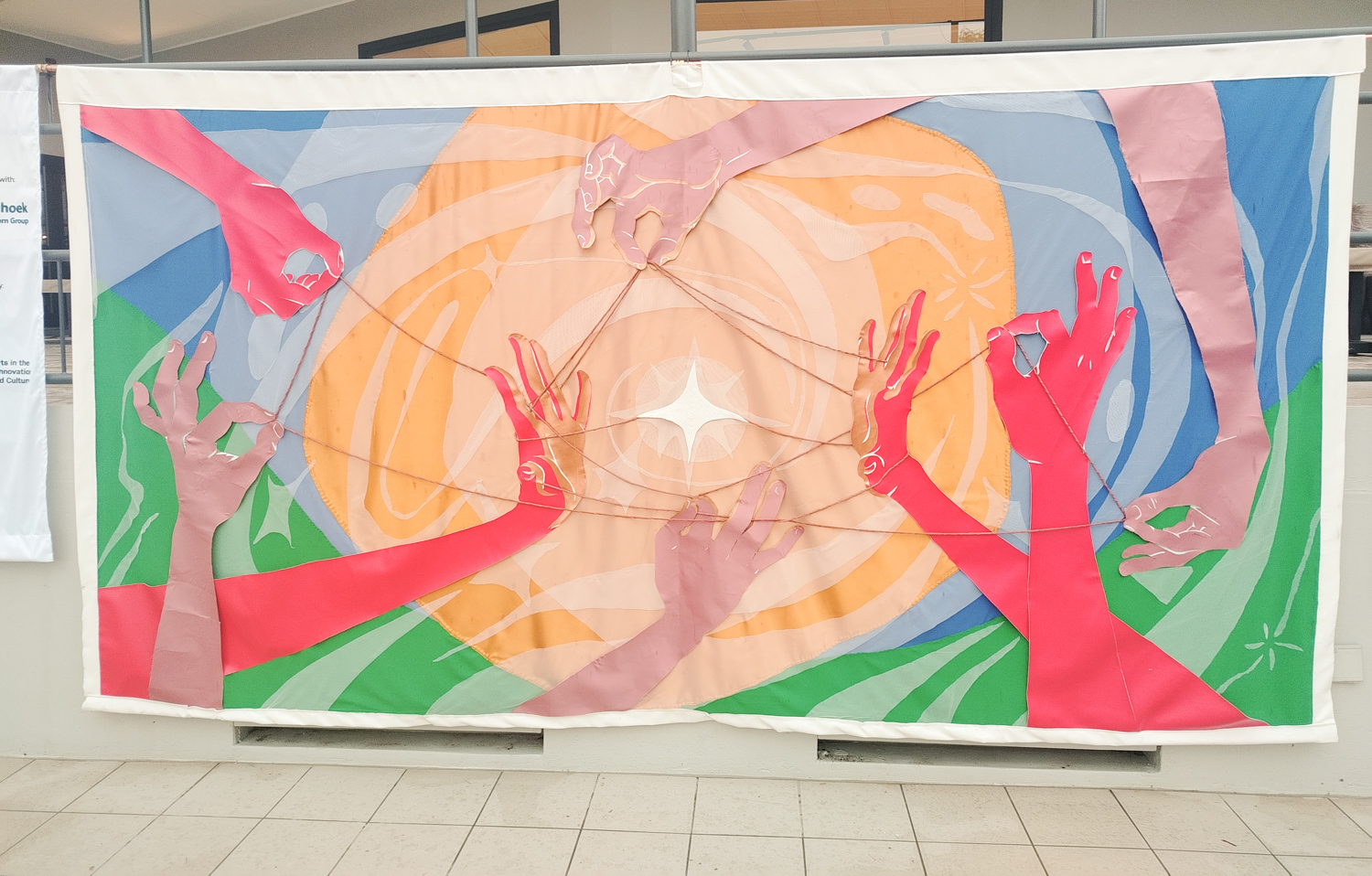
The future does not simply arrive. Instead, it is constructed by present choices which, in turn, are anchored in the past. The future is shaped by stories and their storytellers.
Materials used were acrylic paint, cotton, embroidery thread, faux leather, felt, mesh, polyester satin and sewing thread.
Made by Turipamwe and Alexandra Dunaiski with contributions from Elsa Dunaiski and Kato Van Niekerk.
MERCHANDISE
PENDELABRA
Using salvaged copper pipes, 4mm metal threading, pipe cutter, and glue, the “pendalabras”—a name coined by Devon Walker-Figueroa—are radiator-style pen holders designed to provide writers with a unique device for storing their precious writing instruments. Each individual pen holder can be tilted to achieve the optimum angle for inserting and withdrawing pens or pencils.

Over time, each pendalabra develops a patina which can be removed using tartaric acid, bicarbonate of soda, or standard copper polish.


100 pendalabras were made by Ange Mucyo and Rémy Ngamije for the festival sponsors, partners, and guests.
BOOK JACKETS
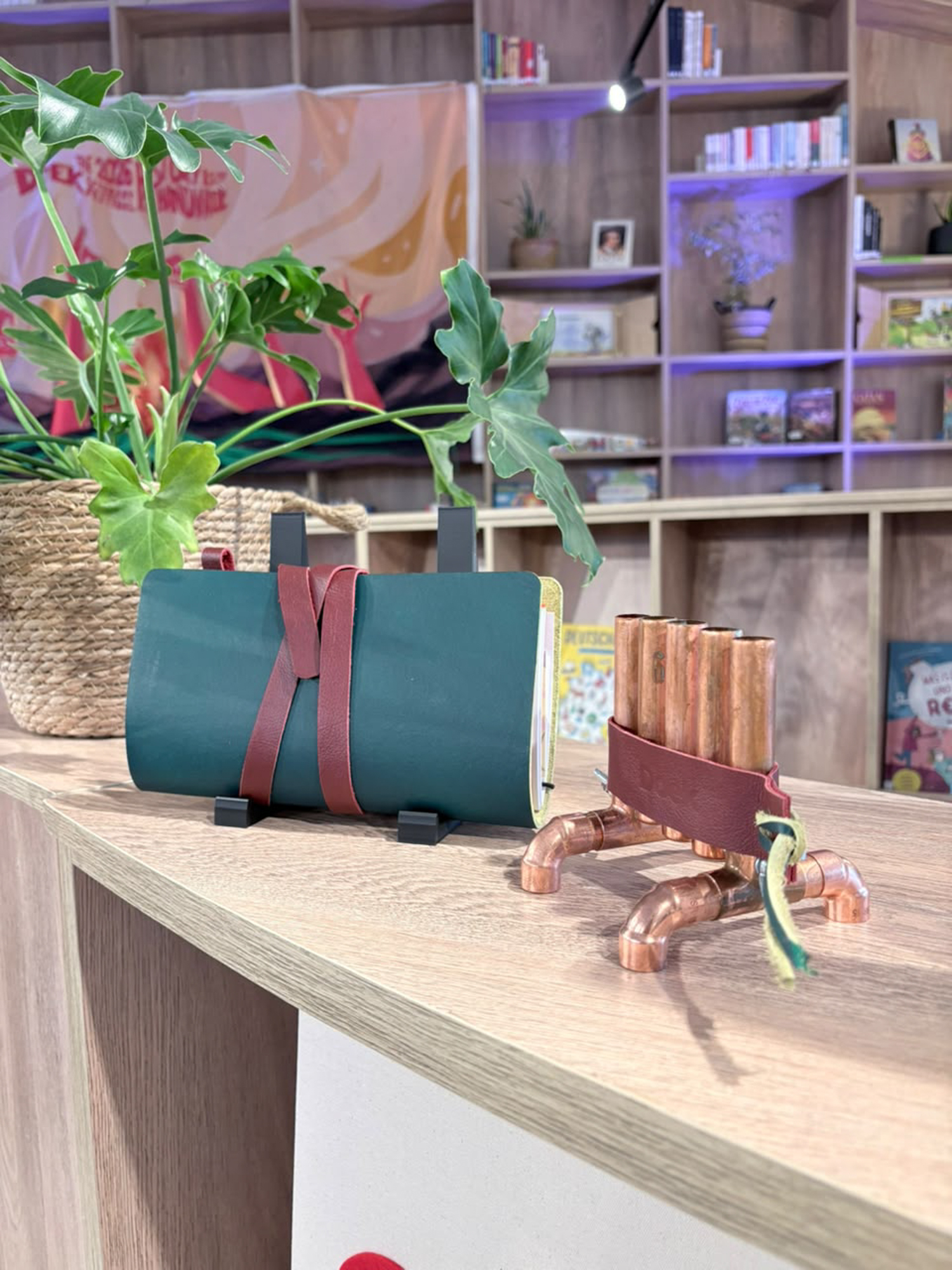
Made from deep green and red Namibian leather, the notebook jackets are designed to be hardy and last any writer a lifetime of travelling and storytelling. They are designed as travel companions with dimensions that can accommodate notebooks, passports, boarding passes, receipts, bookmarks, and any other odds and ends that a storyteller might collect on their journey.
Each notebook is green to represent the Goethe-Institut’s ongoing support for the Doek Literary Festival through the provision of a venue and bound together by a red strap representing Bank Windhoek as a connector of positive change.
100 book jackets were made by Quin-Leigh Hammond and engraved by Remy Ngamije for the festival sponsors, partners, and guests.
NOTEBOOKS
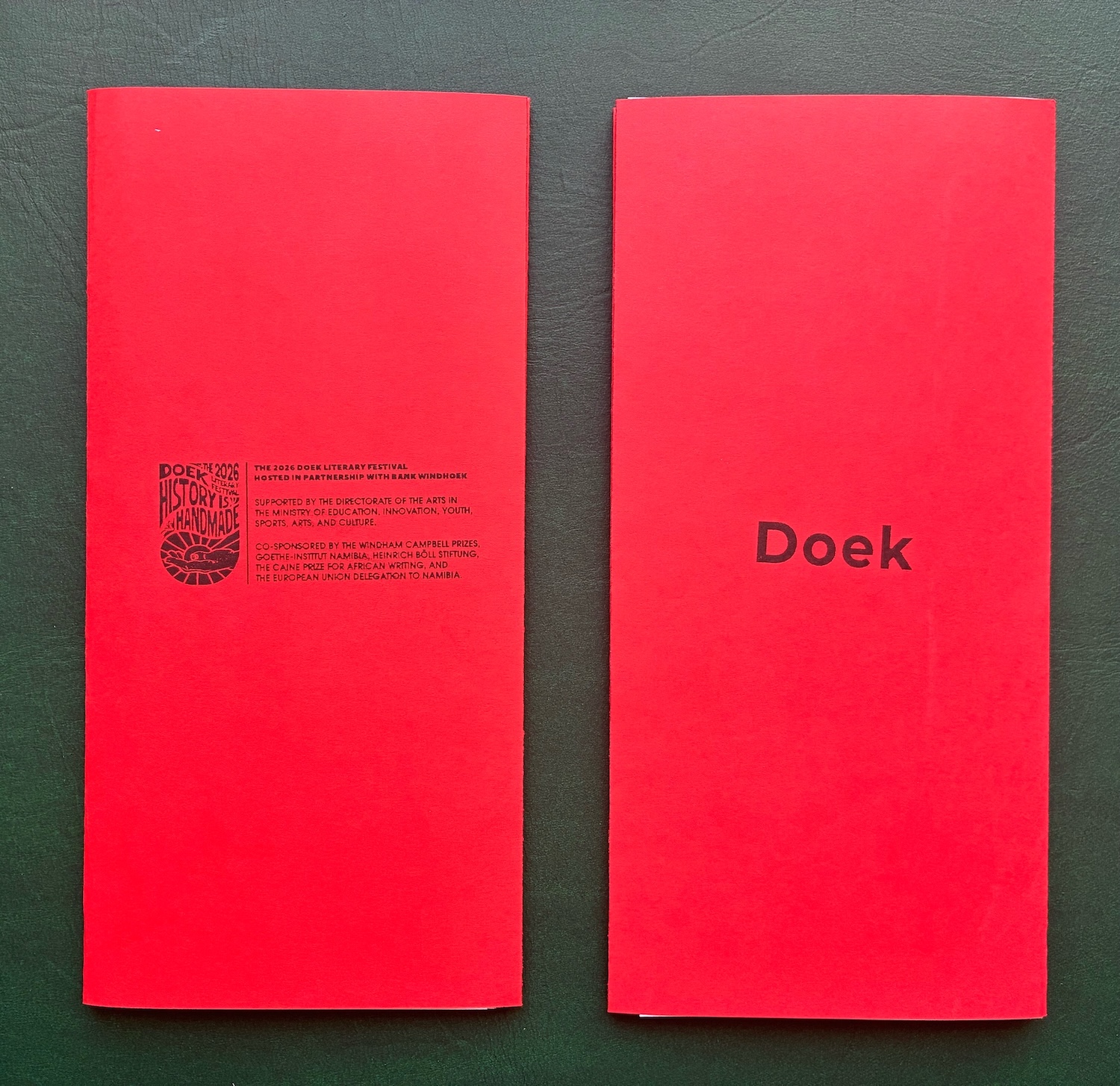
The notebooks are hand-folded using 100GSM red card stock for the cover which represents Bank Windhoek’s ongoing support for the Doek Literary Festival and plain 80GSM white paper that is easy to write on.
The front of the notebooks is hand-stamped with the official festival brandmark of the 2026 Doek Literary Festival which was designed by Alexandra Dunaiski, with art direction from Elrico Gawanab from Turipamwe.

The back cover of the notebook bears Doek’s stamp which was also applied by hand.
400 notebooks were made by Ange Mucyo and Rémy Ngamije with contributing efforts by Mekondjo Angula. They were provided free-of-charge to all workshop attendants as gifts for the festival sponsors, partners, and guests.
OWARE BOARD GAME
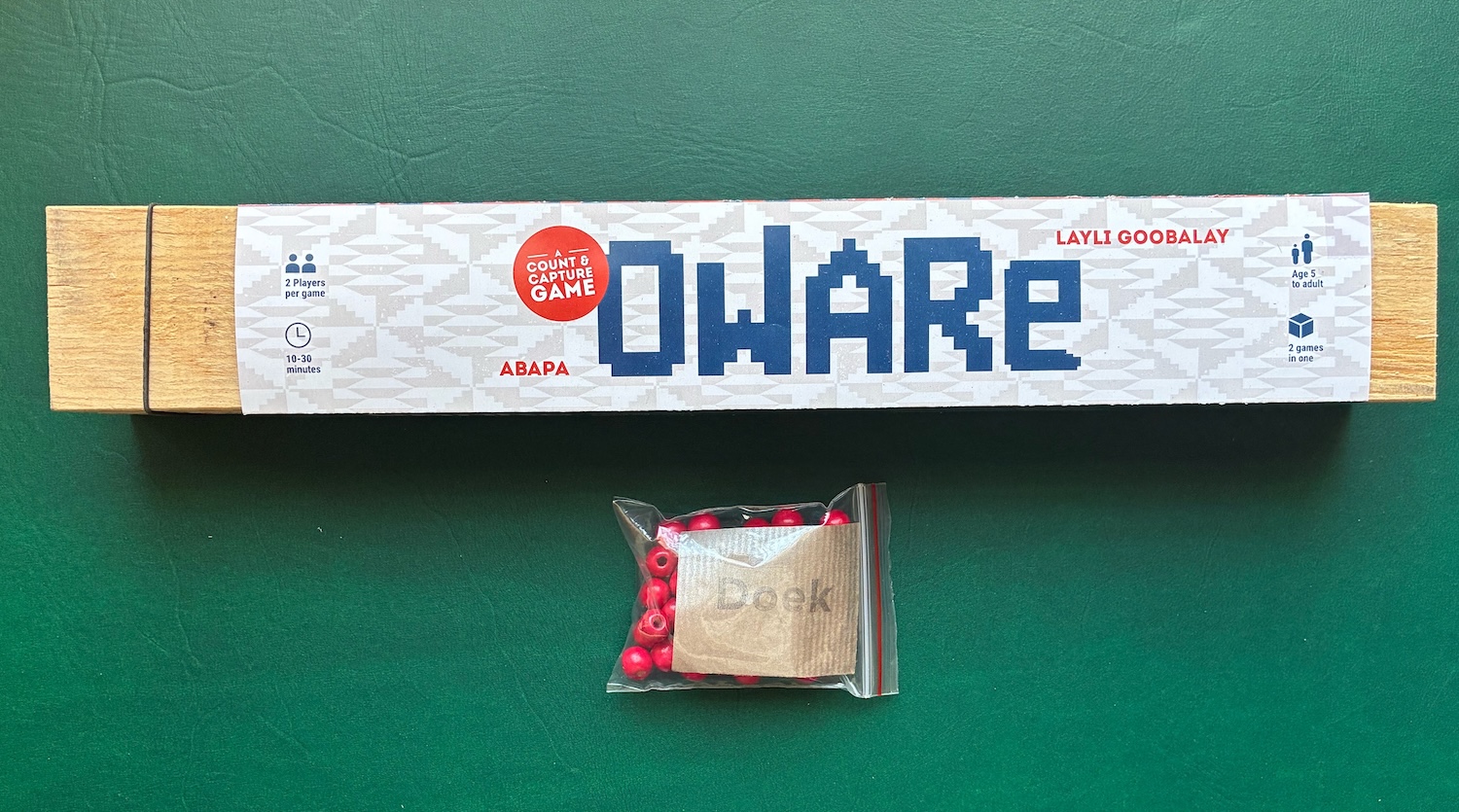
Board games are analogue means of spending time with friends or strangers in friendly competition. Their slow, deliberate, and turn-based system of play enables dialogue to still take place even as complex gameplaying strategies unfold.
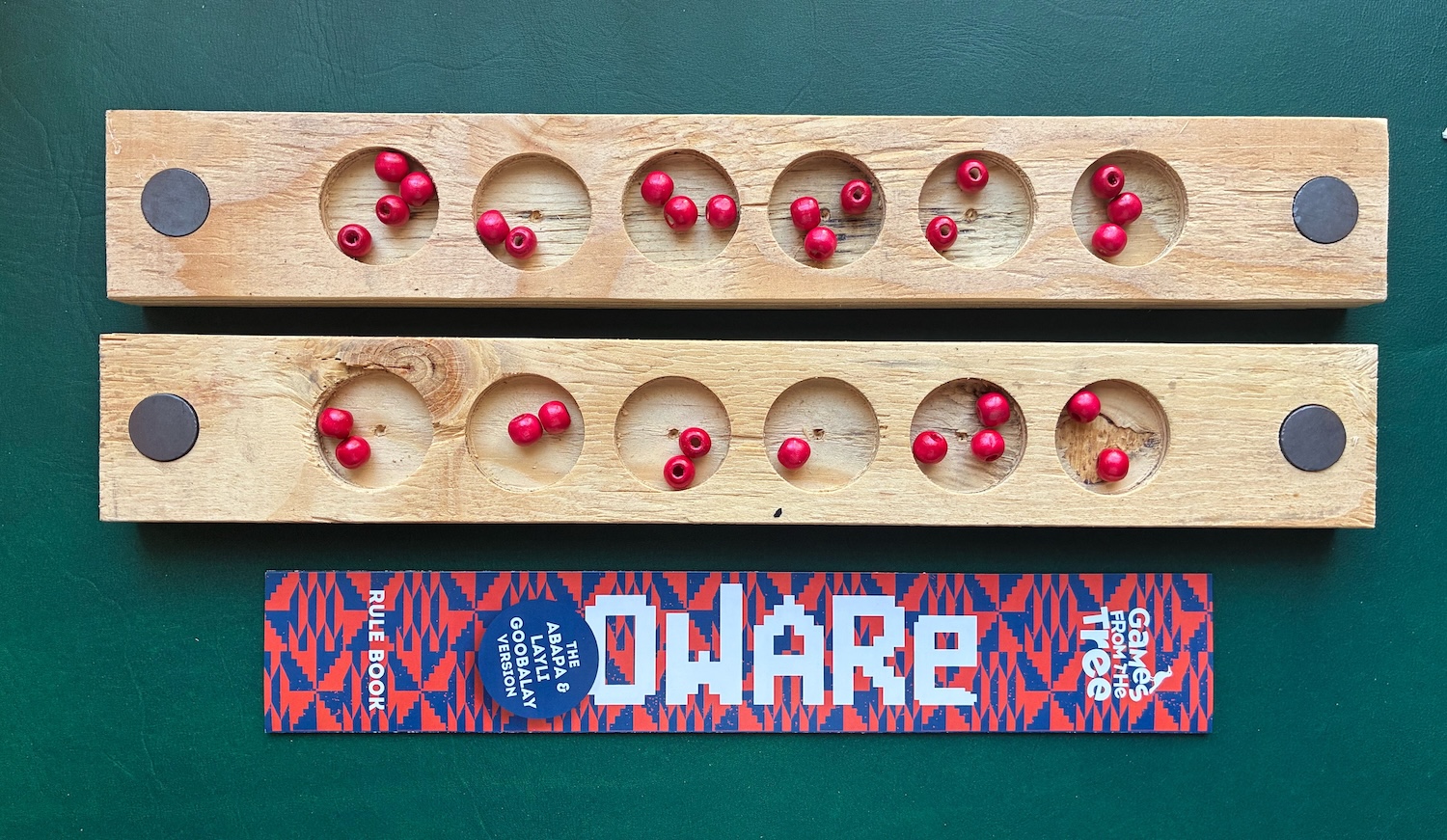
The Oware Board Game offers two playing styles: one from Ghana and one from Somalia. It was made from a rescued shutterboard by Ange Mucyo and Rémy Ngamije based on the original concept by Clara Mupopiwa.

The board game packaging, designed by Clara Mupopiwa, reflects Bank Windhoek’s branding elements while the playing beads also carry through the red element in the bank’s logo.
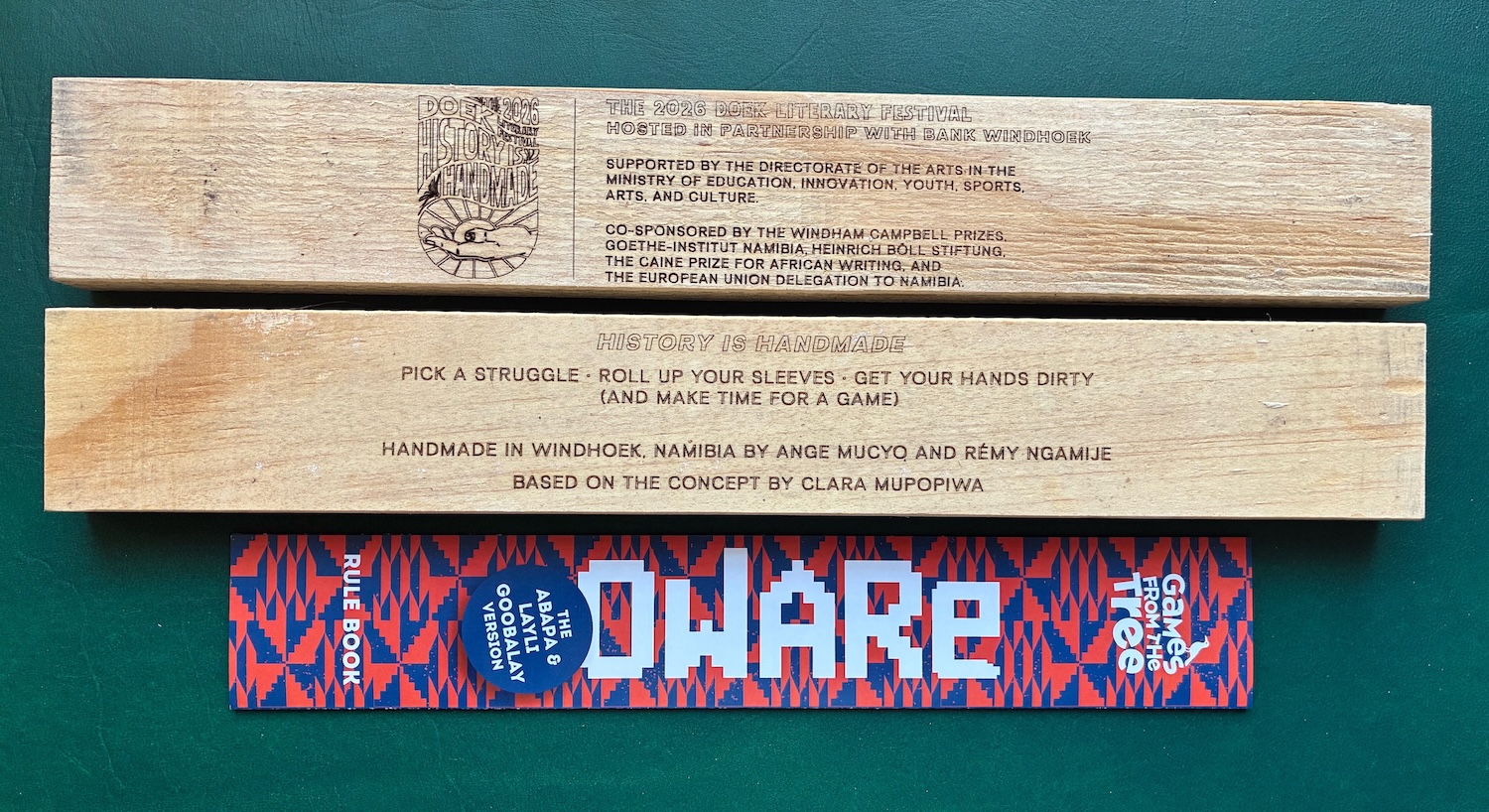
85 Oware Board Games were made for the festival’s sponsors, partners, and guests.

TOTE BAGS
The cotton tote bags were designed to carry books, writing materials, and other paraphernalia that storytellers might collect on their journeys. They are 32cm x 32cm to accommodate the dimensions of a vinyl record, an analogue music element that was a part of the 2026 Doek Literary Festival.
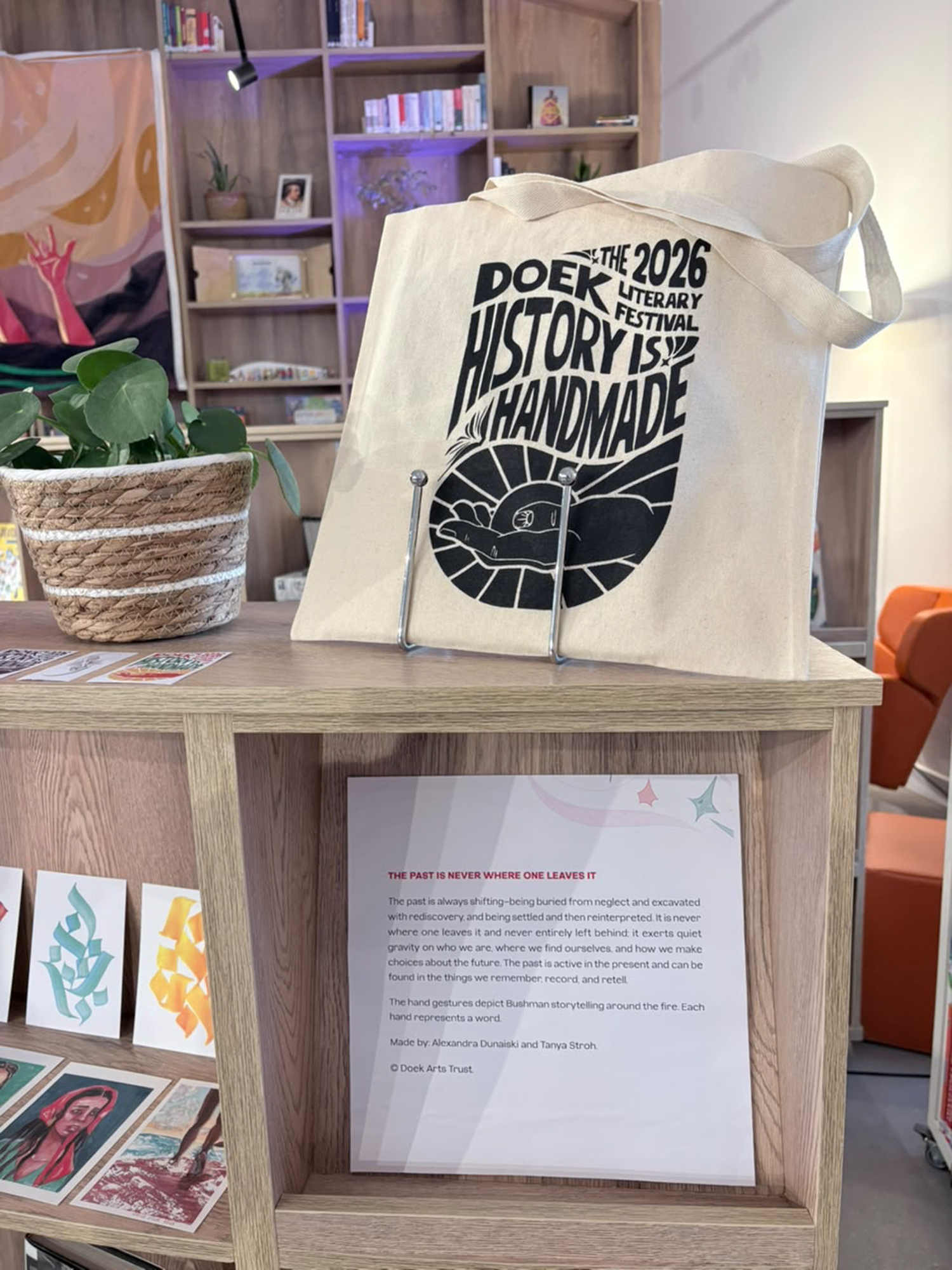
The festival brandmark and key festival sponsor logos were applied on to the front and reverse of the bags using silk-screen printing techniques.
100 bags were made by Quin-Leigh Hammond for the festival sponsors, partners, and guests.
LP COVERS
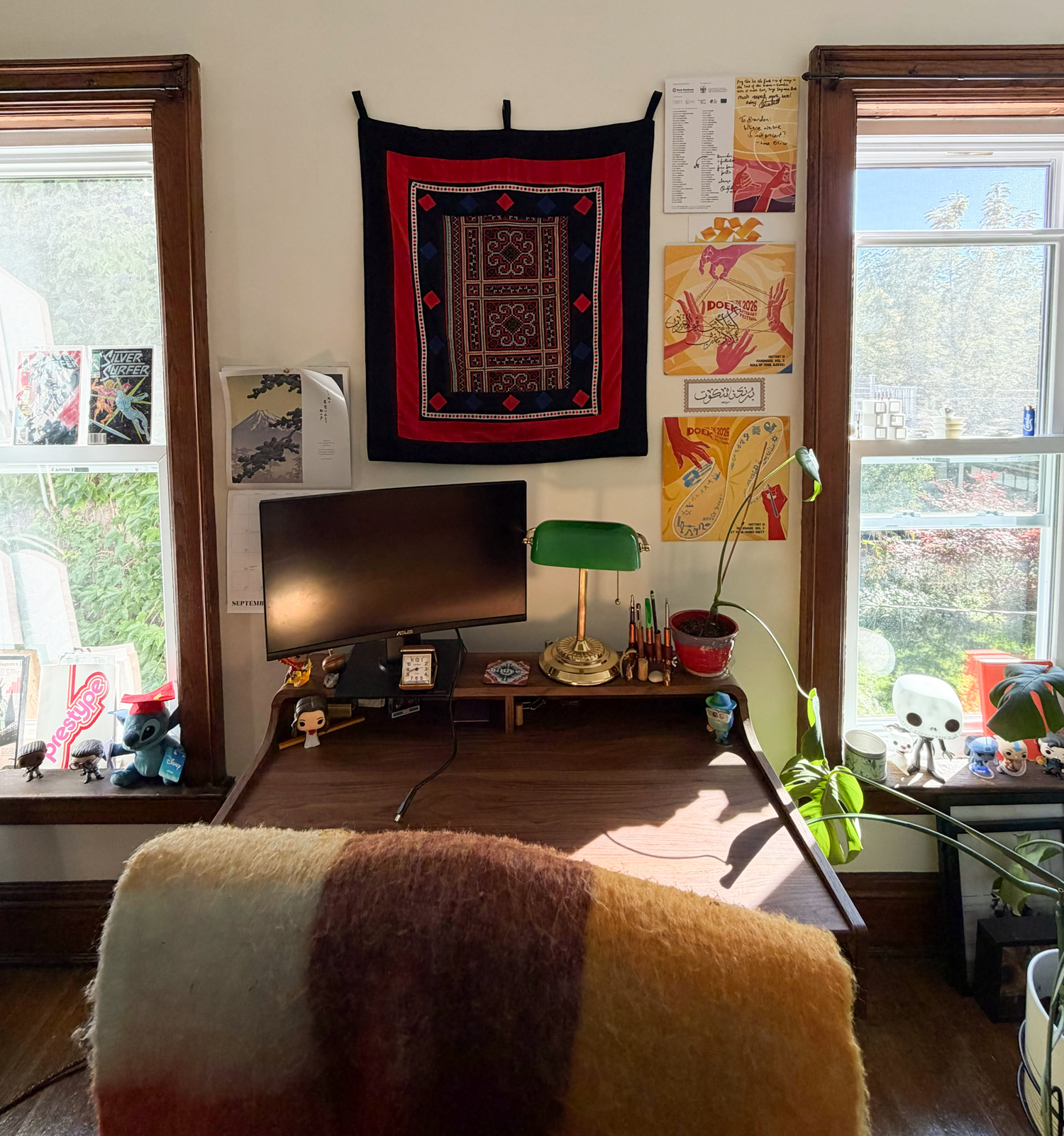
Limited and collectible, the LP covers drew inspiration from the tapestries and featured artwork by Alexandra Dunaiski, with art direction from Elrico Gawanab from Turipamwe.
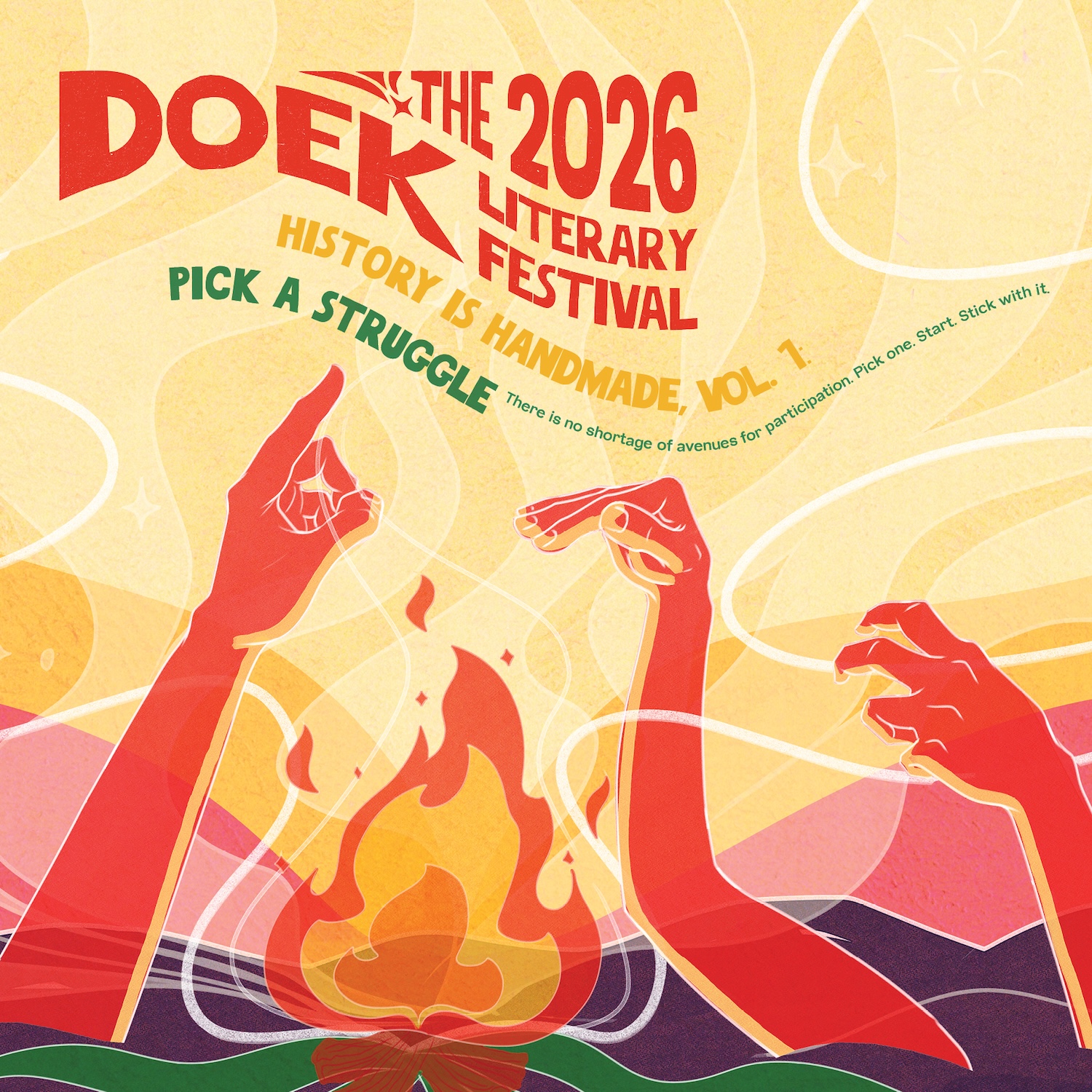
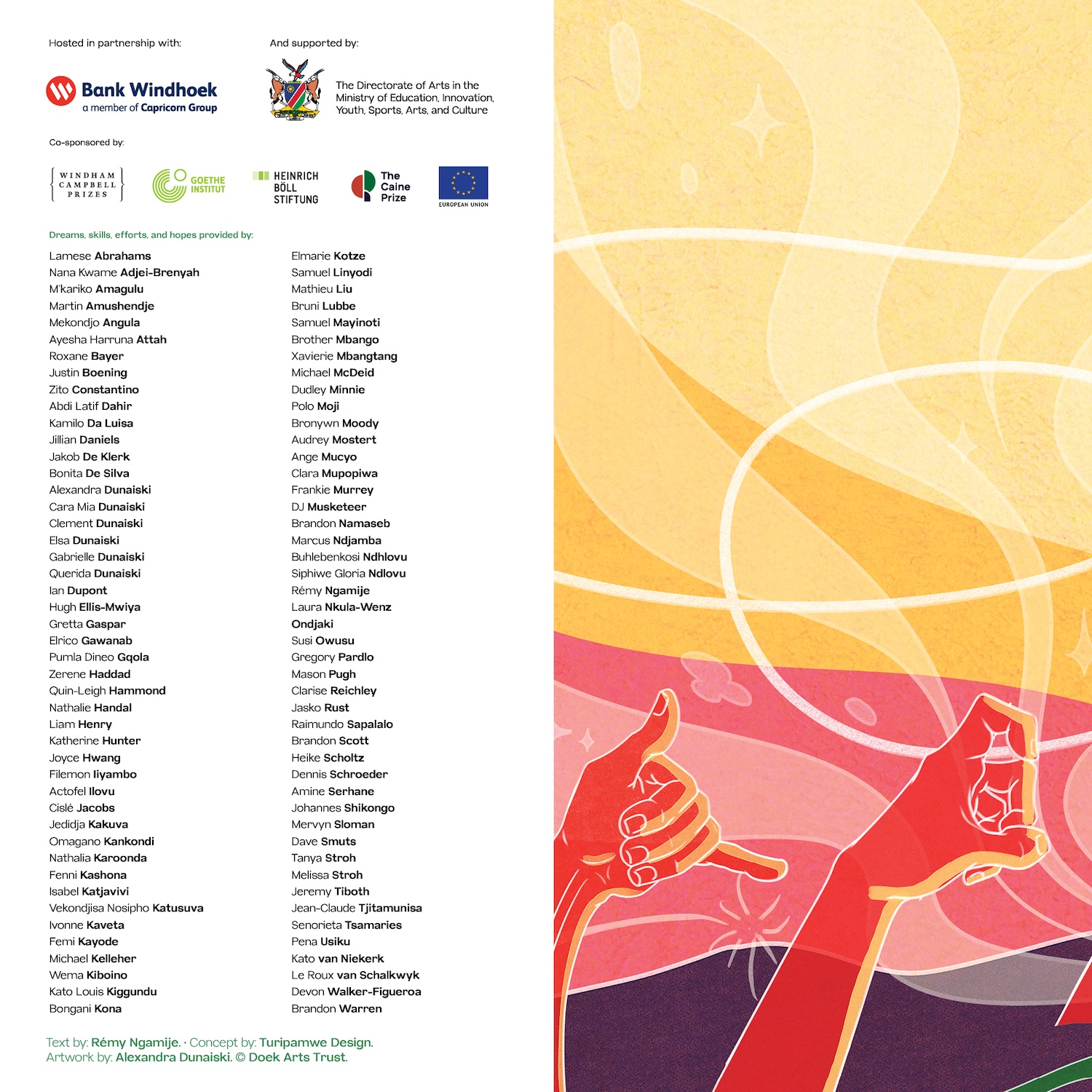
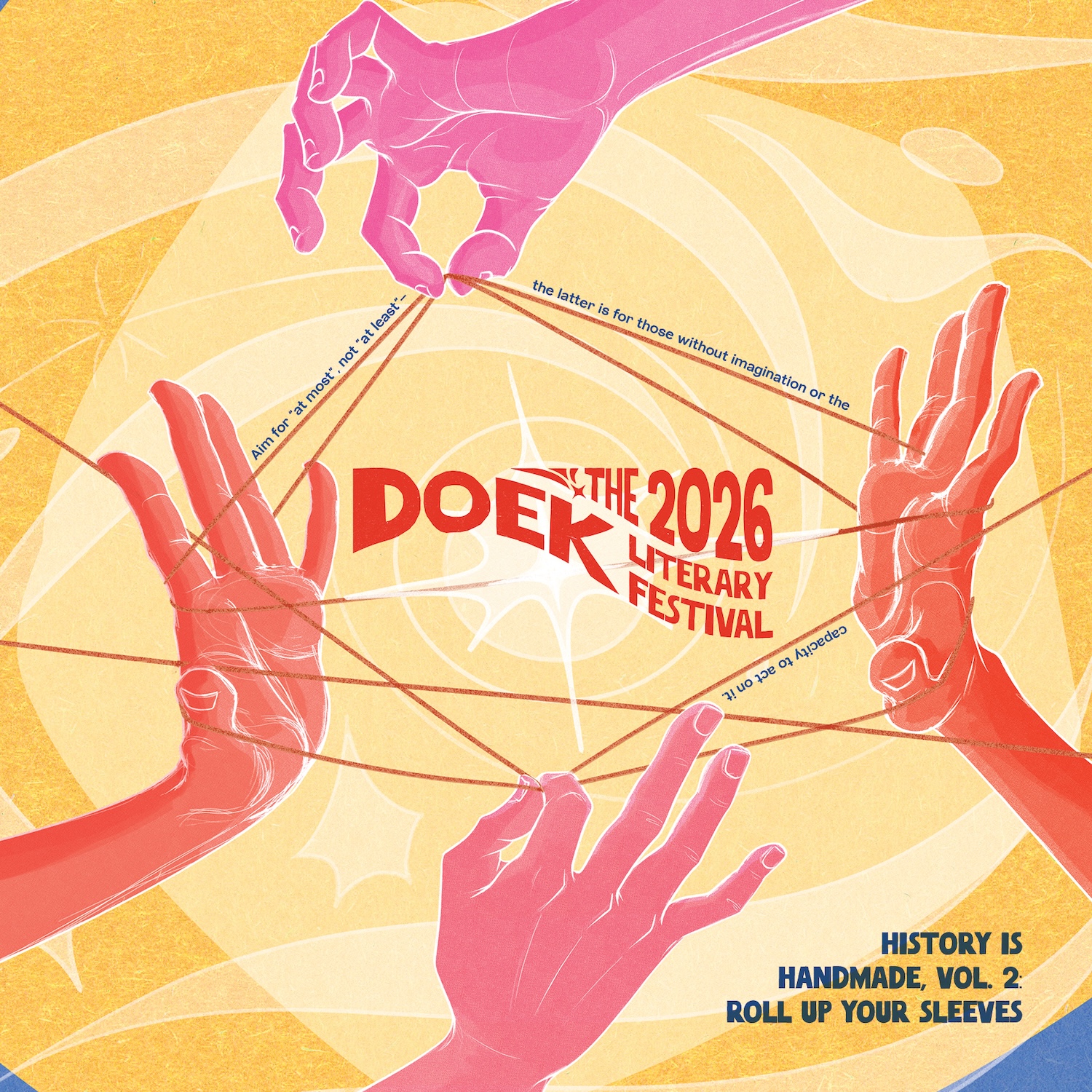
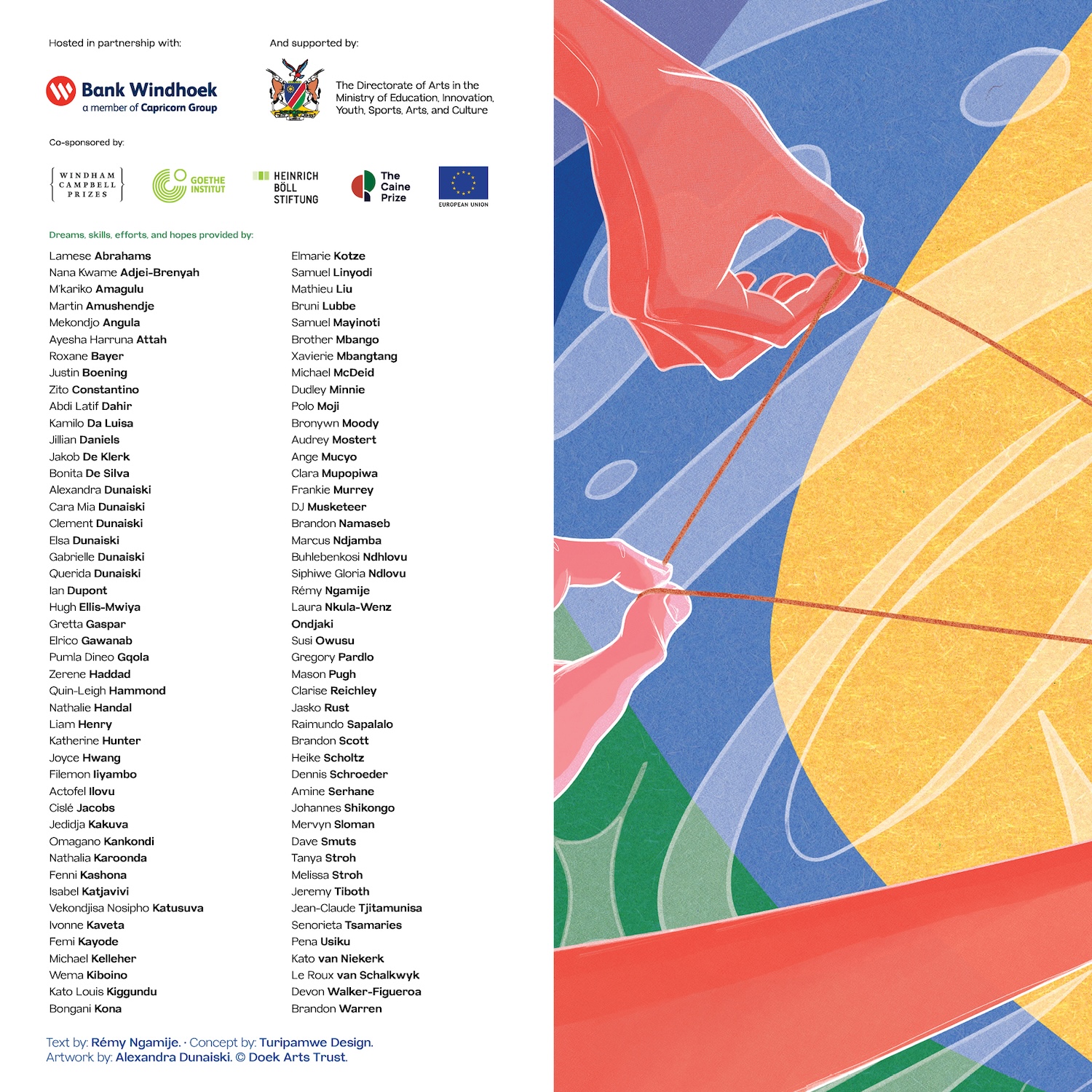
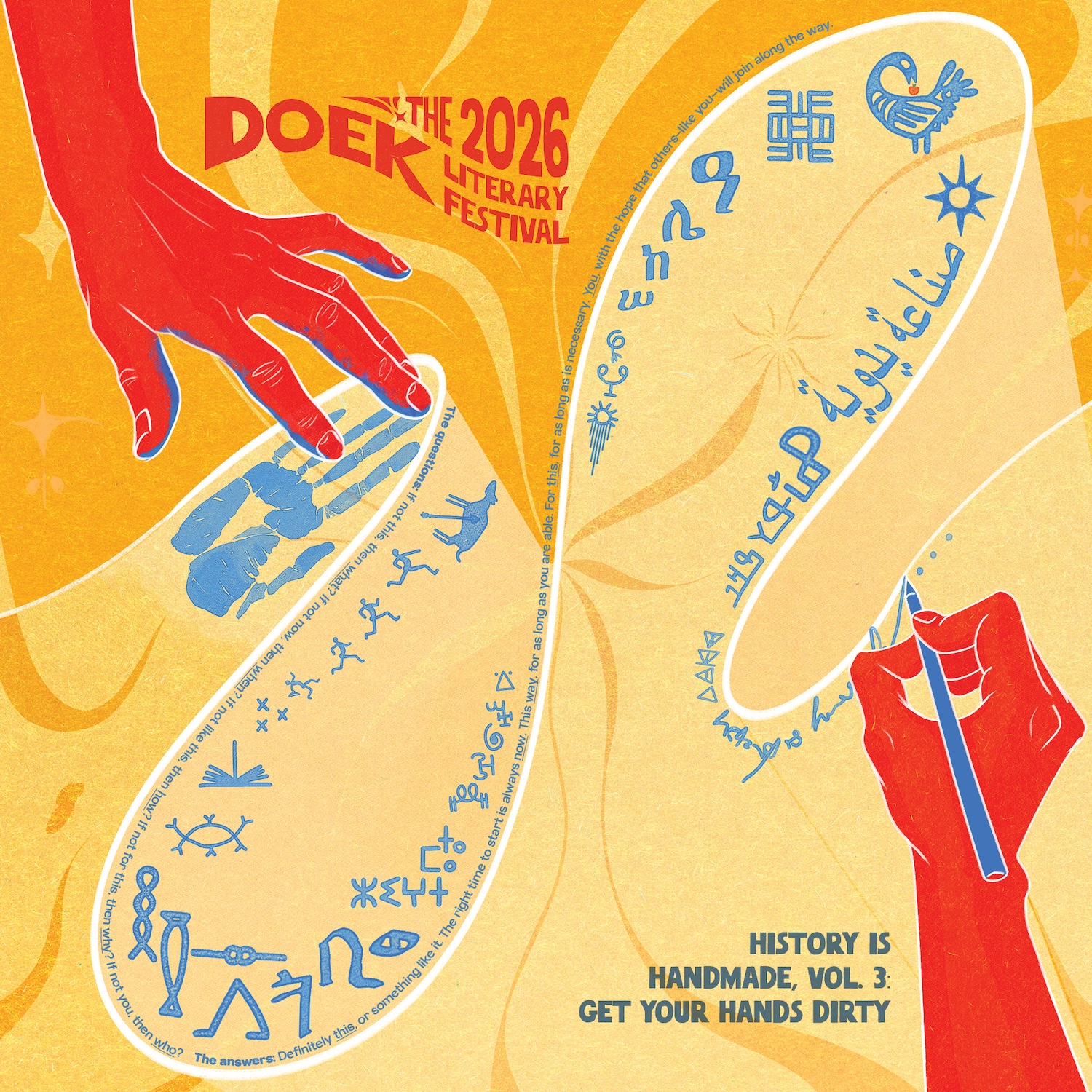
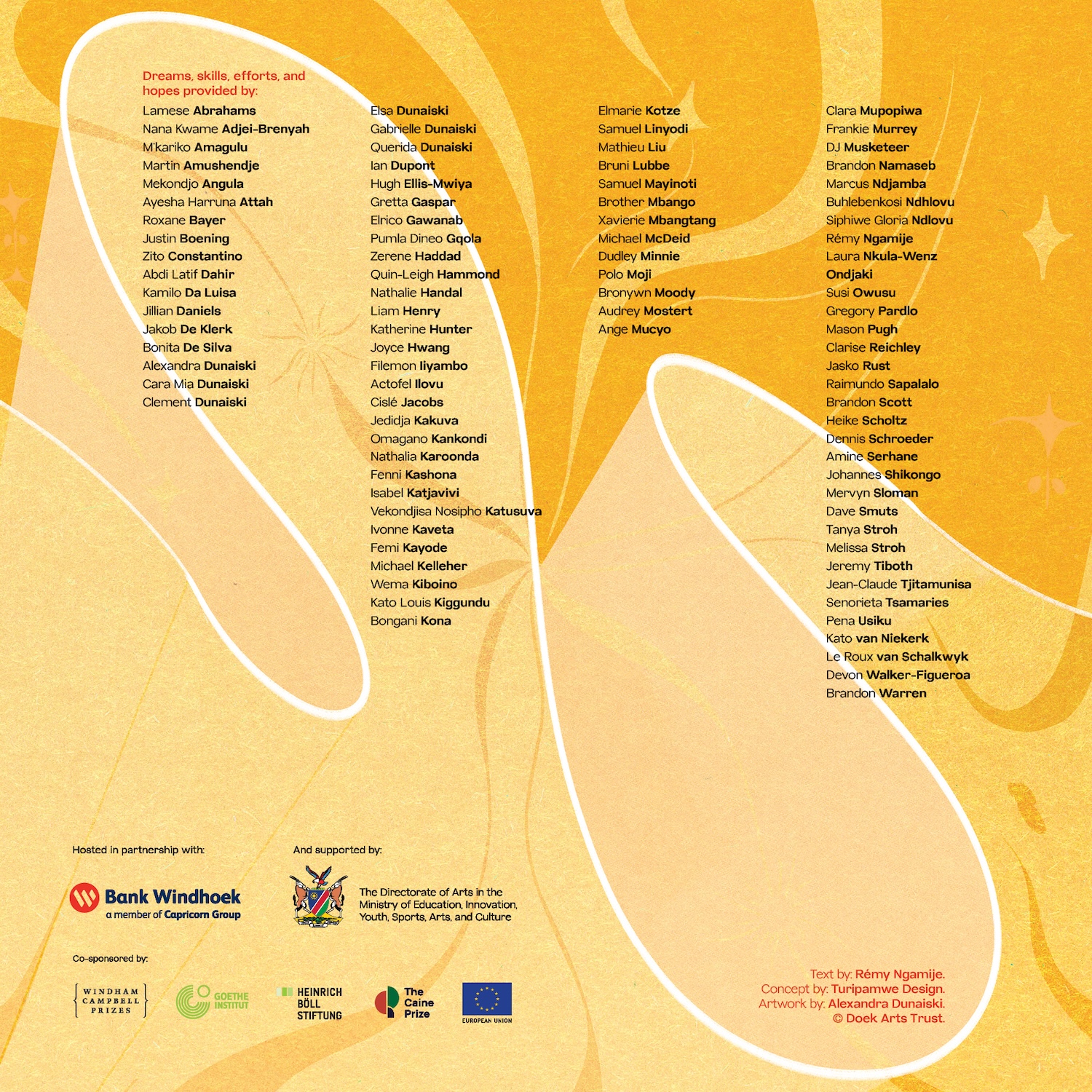
100 of them were printed and assembled by the Turipamwe team for the festival’s sponsors, partners, and guests.


Each artwork has liner notes written by Rémy Ngamije and features all the names of all the people who lent their skills, efforts, and to the making of the 2026 Doek Literary Festival.
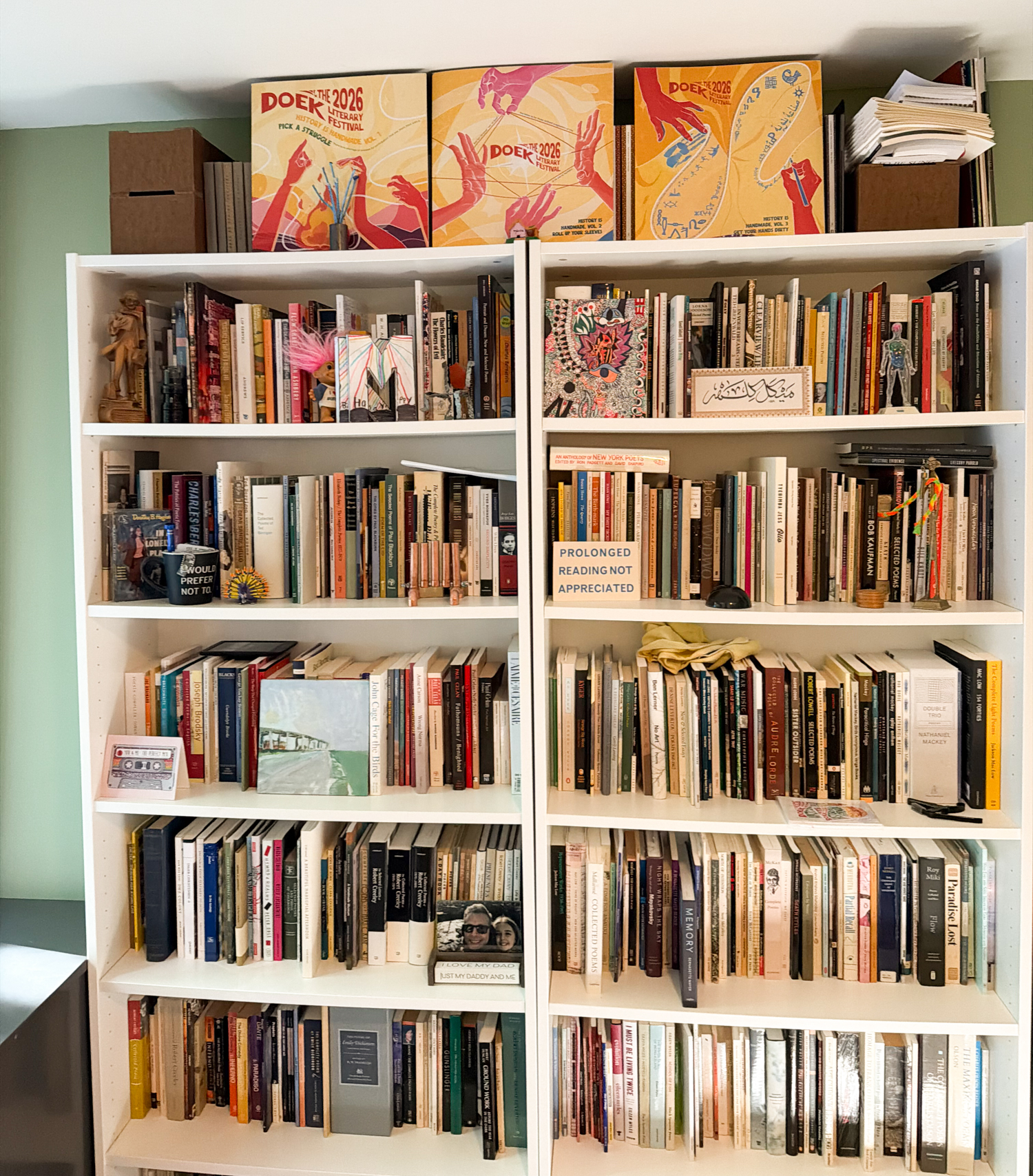
There are three LP covers: Volume 1: Pick A Struggle, Volume 2: Roll Up Your Sleeves, and Volume 3: Get Your Hands Dirty.
BOOK ASSISTS
Made from air-dried clay and painted in purple and blue guinea fowl colours, the book assists are nifty devices that aid in keeping books open with one hand.
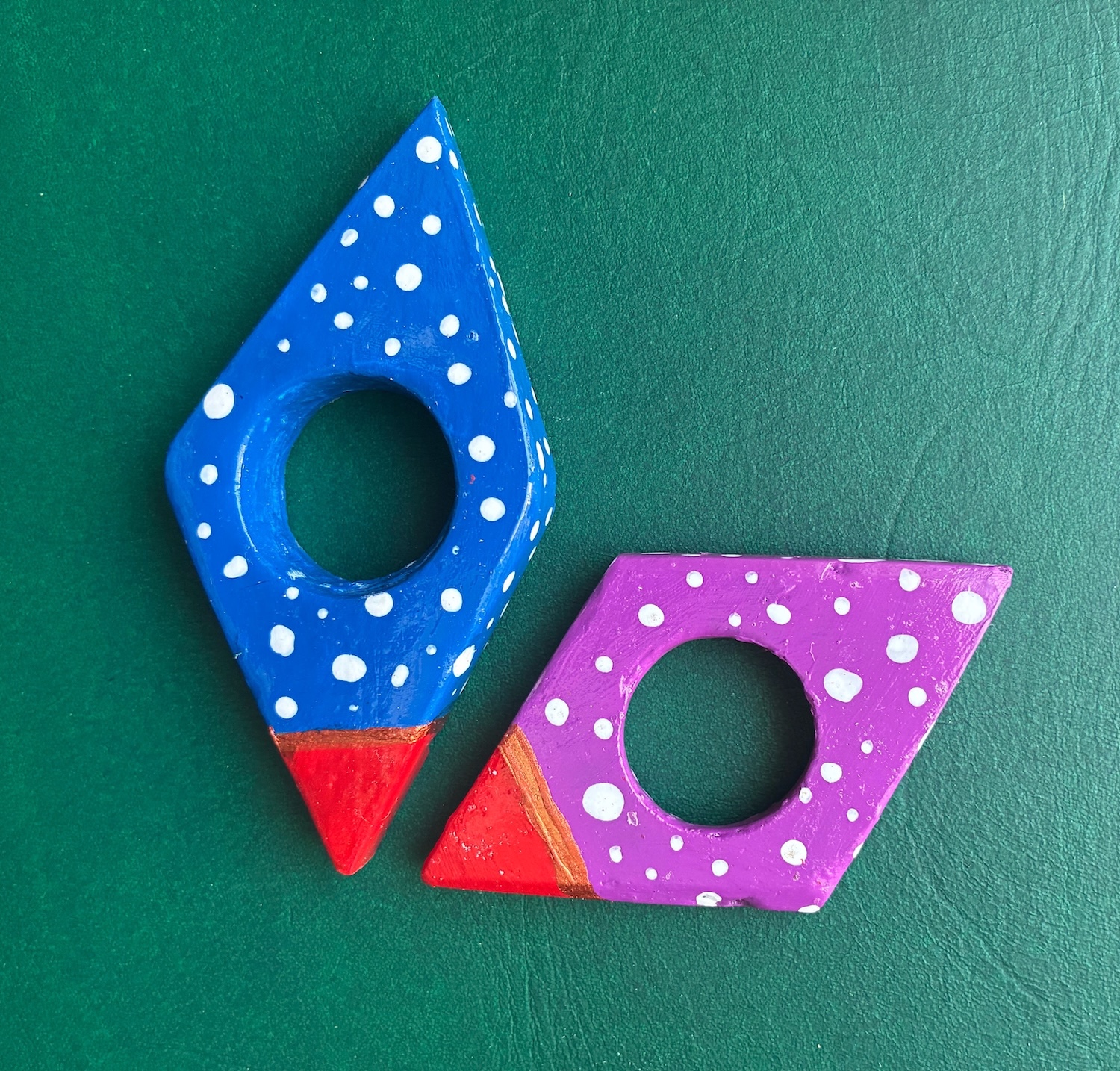
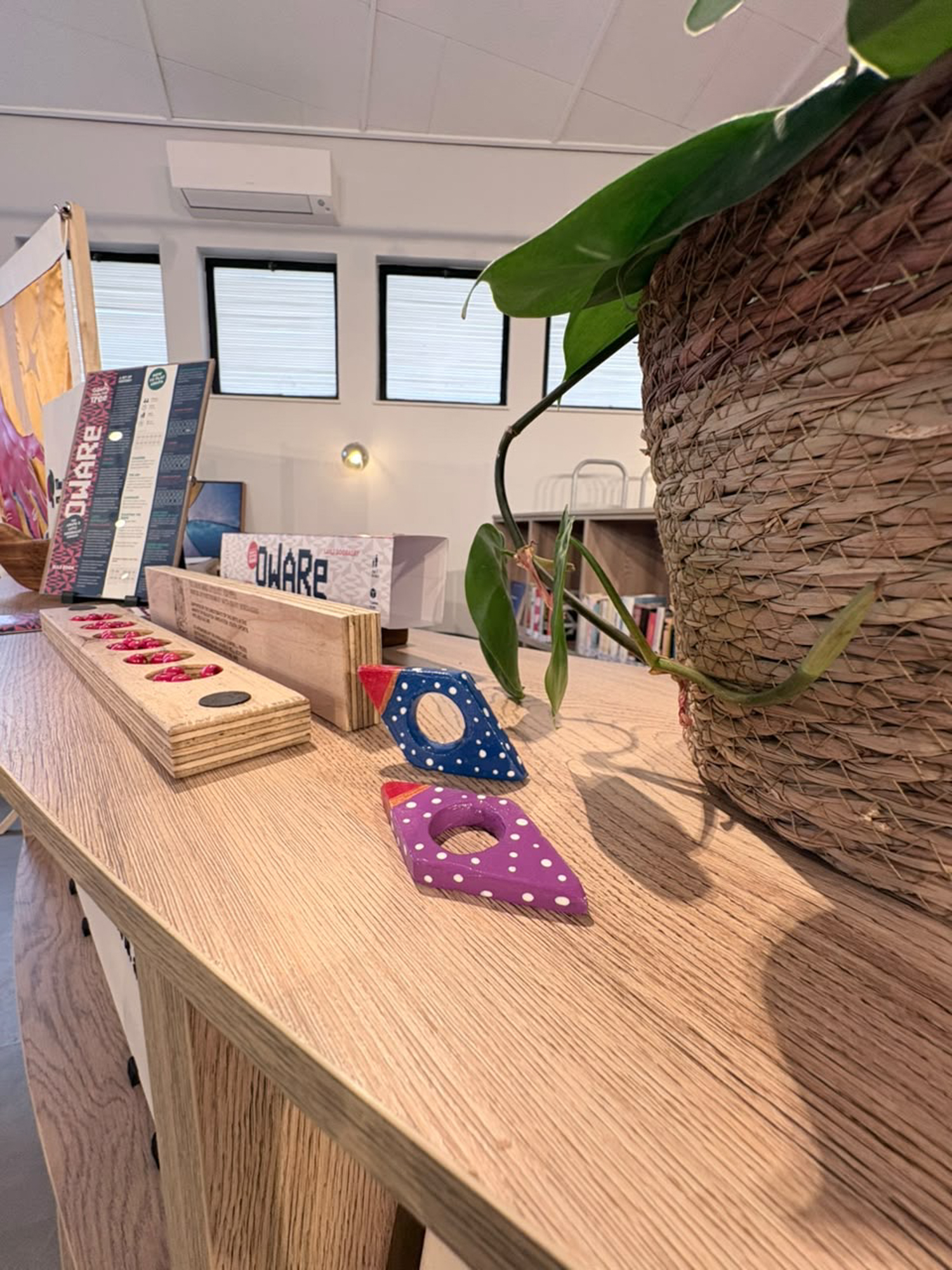
150 book assists were made by Alexandra and Gabrielle Dunaiski with contributing efforts from Jean-Claude Tjitamunisa and Martin Amushendje from Turipamwe for the festival’s sponsors, partners, and guests.

BOOKMARKS
To help avid readers remember where they paused their reading, the bookmarks bear bold artworks featuring Amine Serhane’s calligraphy and the festival’s branding which was designed by Alexandra Dunaiski, with art direction from Elrico Gawanab from Turipamwe.
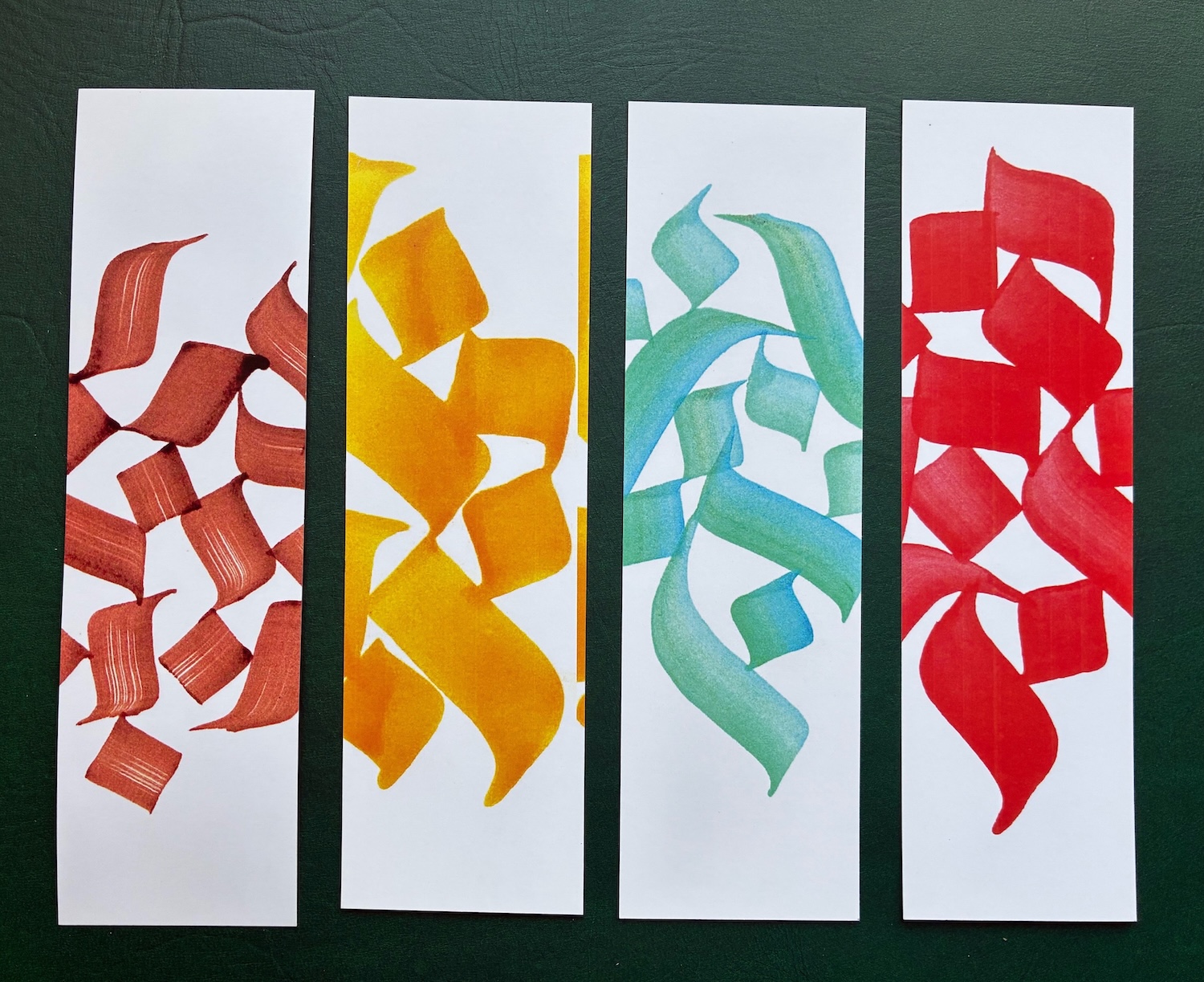
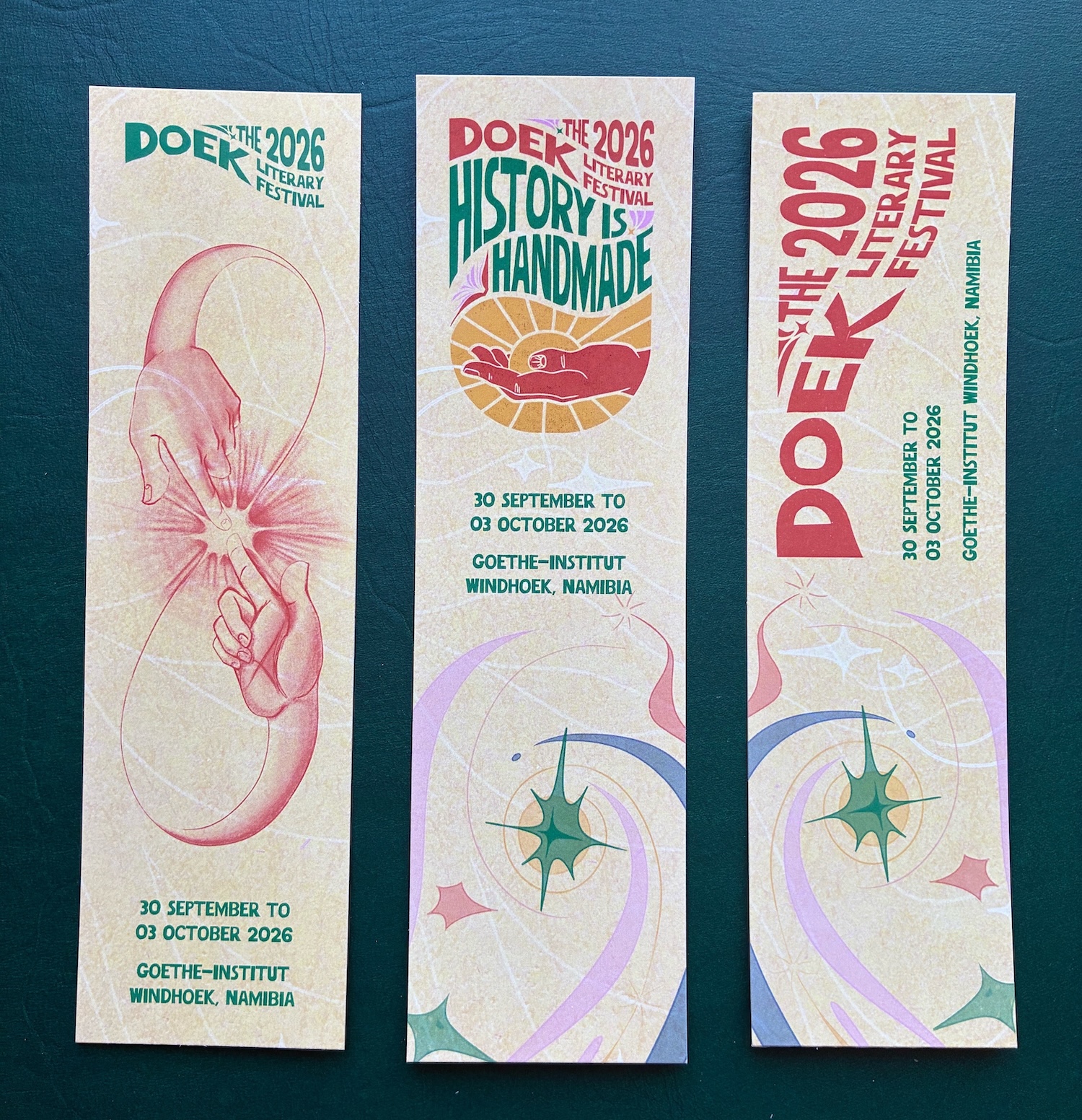
100 copies of each bookmark were printed for the festival’s sponsors, partners, and guests.
POSTCARDS
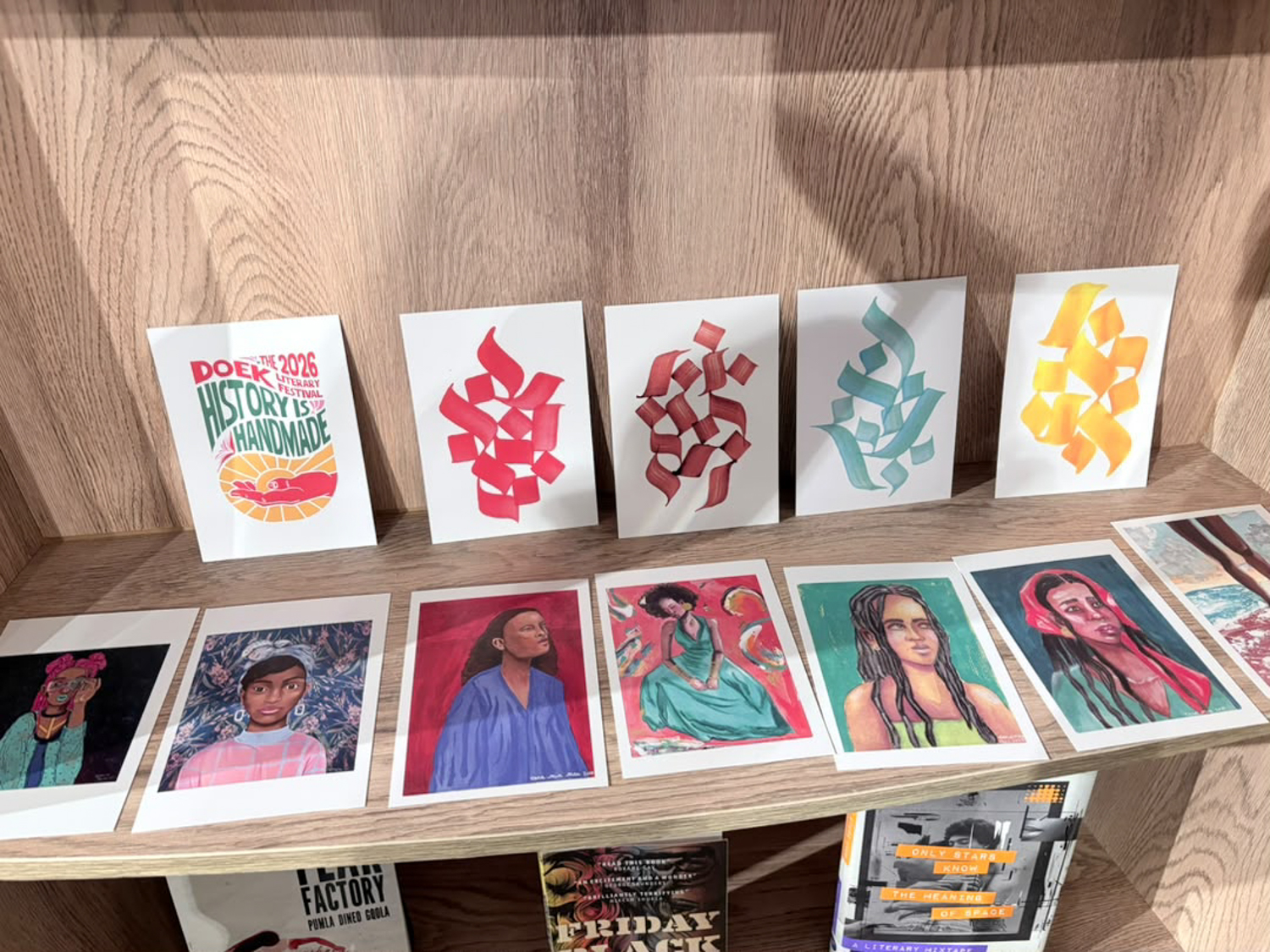
100 copies of each limited edition postcards bearing artworks from Cara Mia Dunaiski, Katherine Hunter, and Amine Serhane were designed by Turipamwe for the festival’s sponsors, partners, and guests to stimulate a return to postal correspondence, one of the best analogue means of communicating with friends and family.
STICKERS
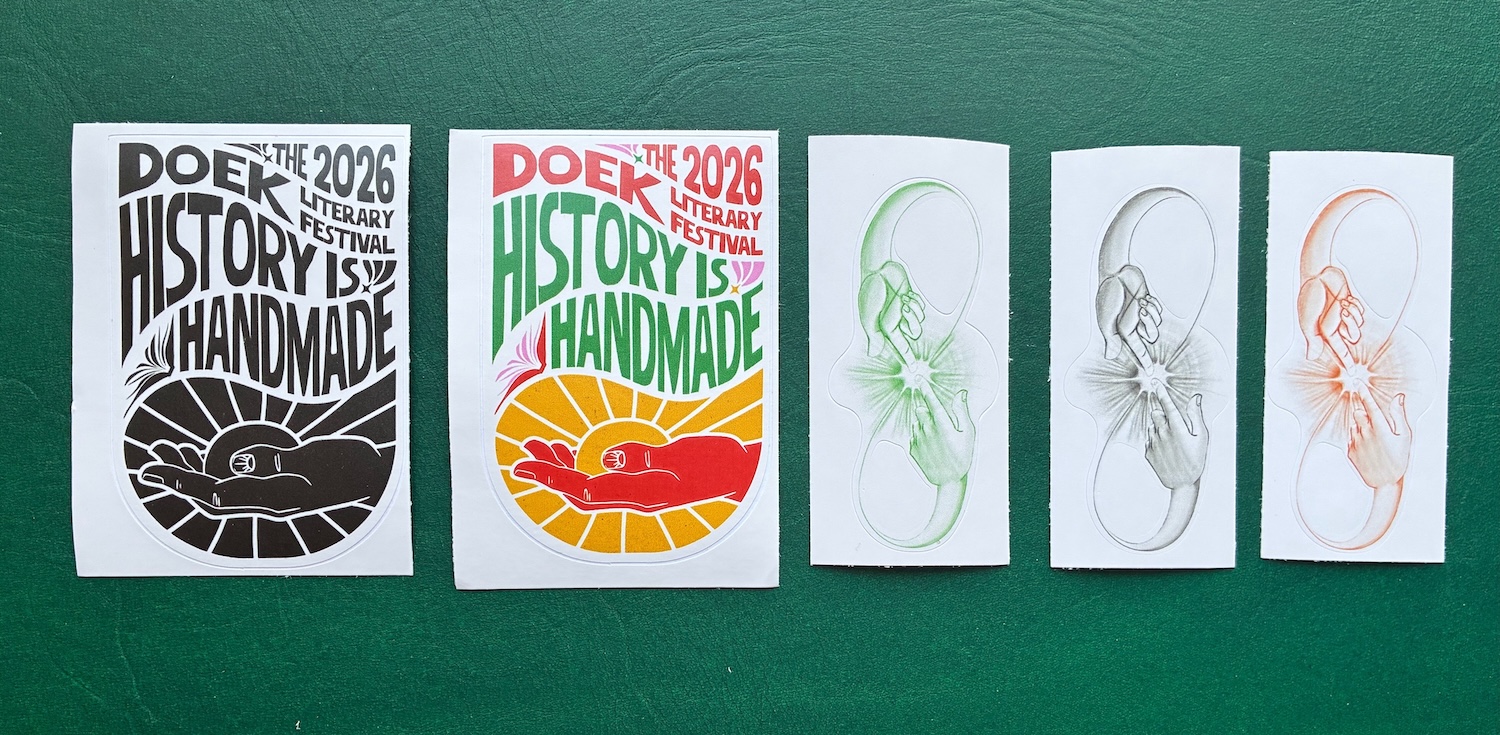
The festival brand mark that was designed by Alexandra Dunaiski, with art direction from Elrico Gawanab from Turipamwe, was translated into black and white and full colour stickers. Each sticker was cut to size and packaged by Rémy Ngamije.
ZINE
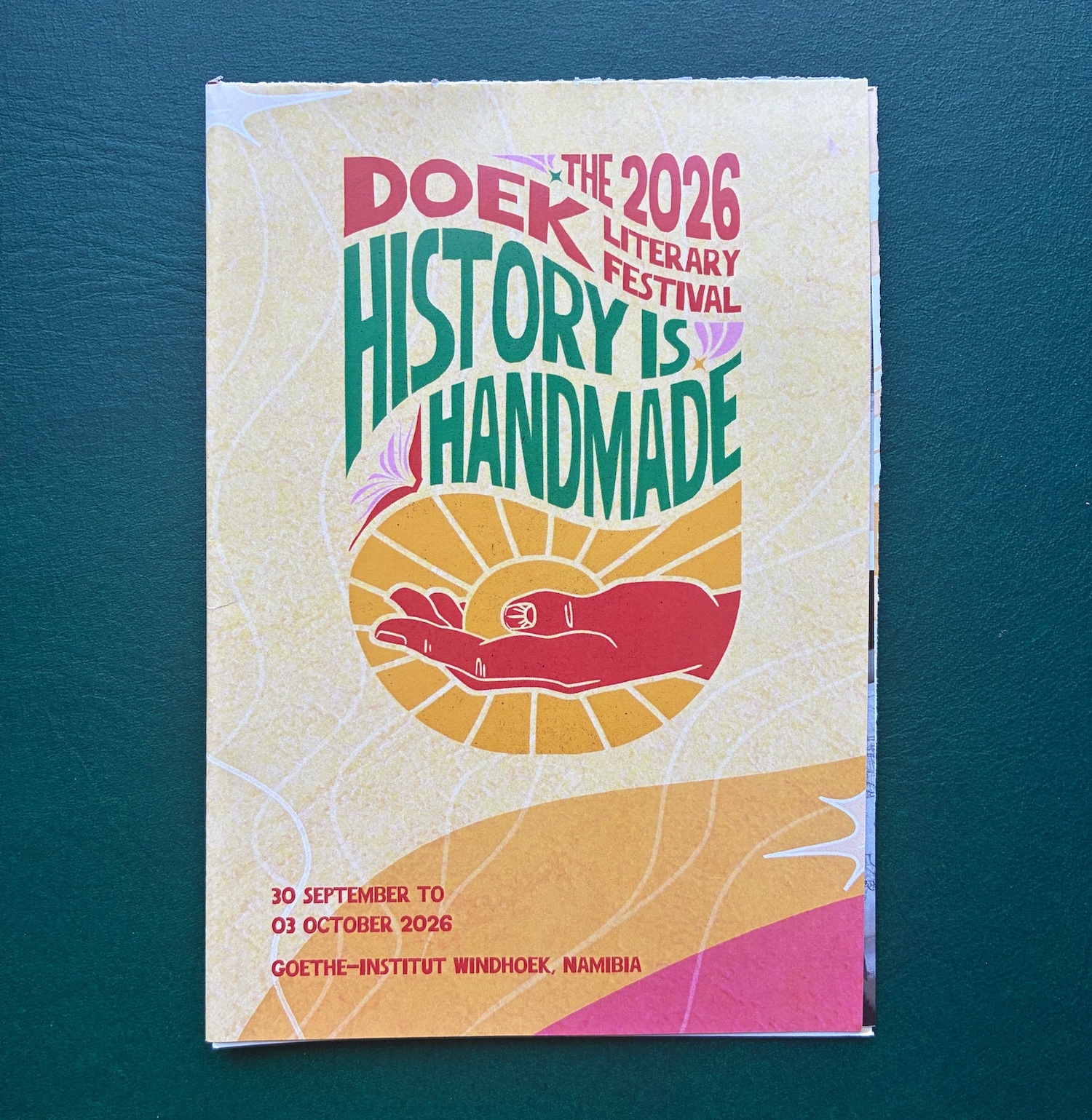
To reduce paper waste, the festival’s program was made available online. However, a small zine was designed and folded by the Turipamwe team as a keepsake for all of the festival’s sponsors, partners, and guests.
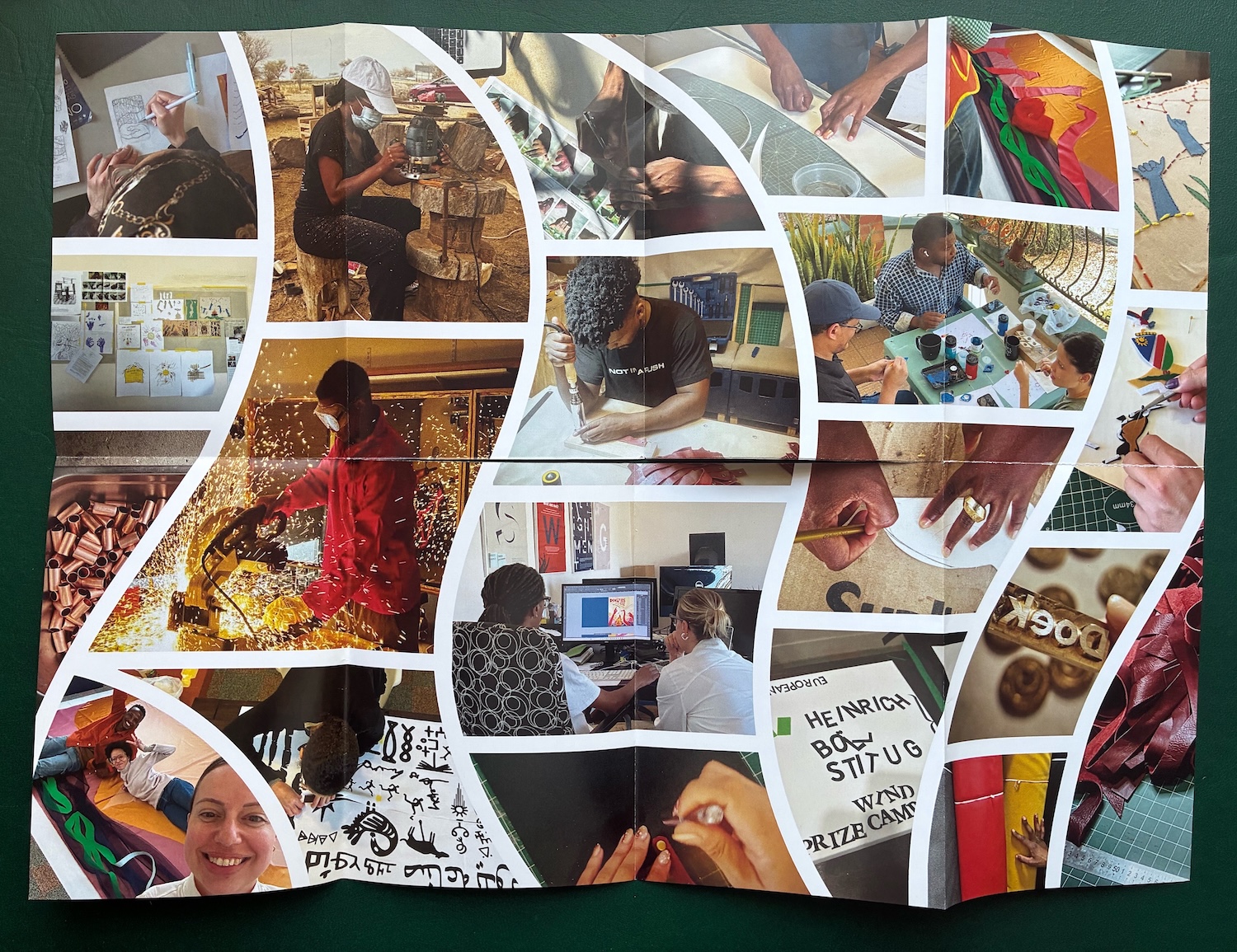
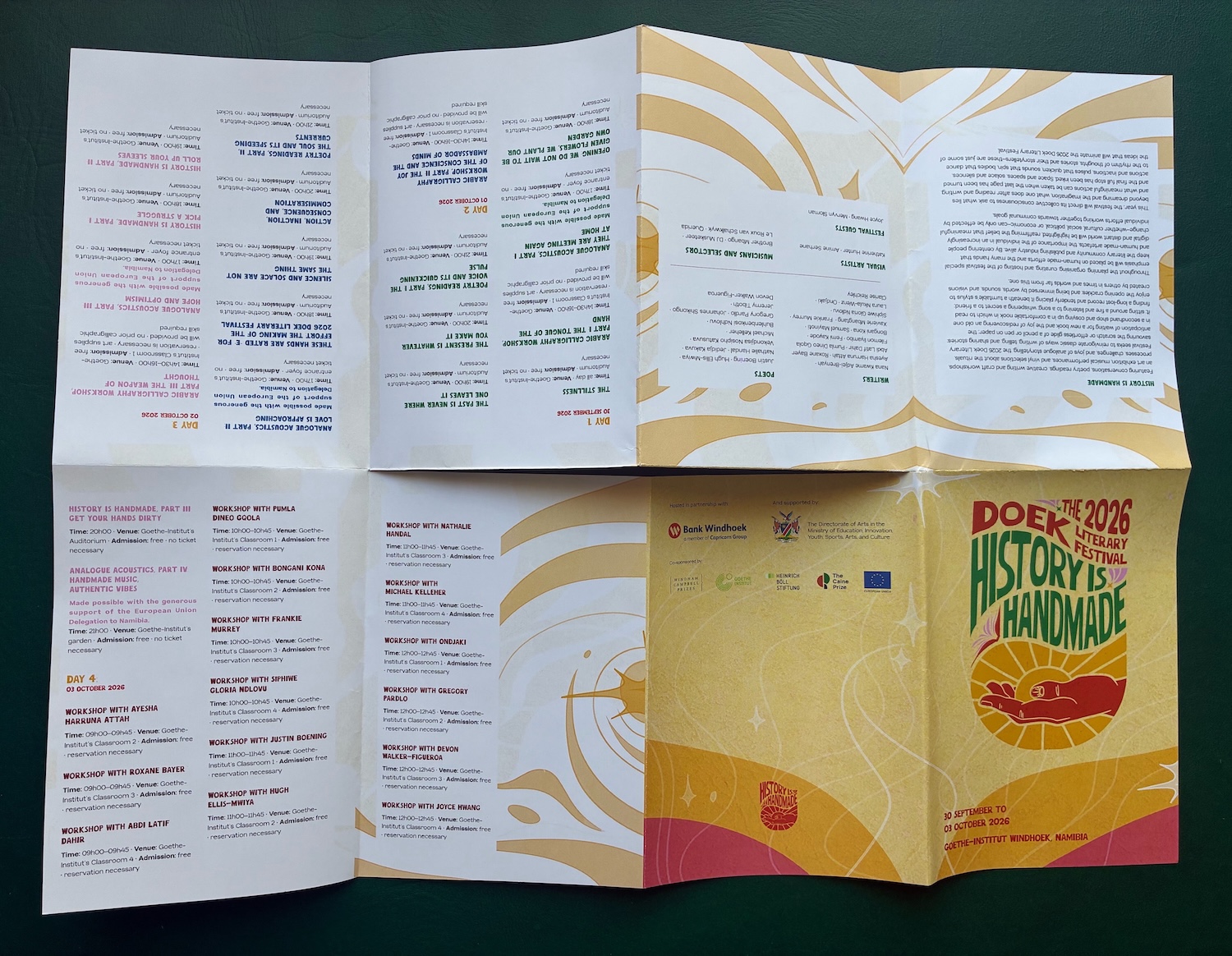
The zine’s artwork was designed by Turipamwe and features photographs from Alexandra and Gabrielle Dunaiski, Elrico Gawanab, Quin-Leigh Hammond, Omagano Kankondi, Rémy Ngamije, and Tanya Stroh.
PARTNER ADVERTISING
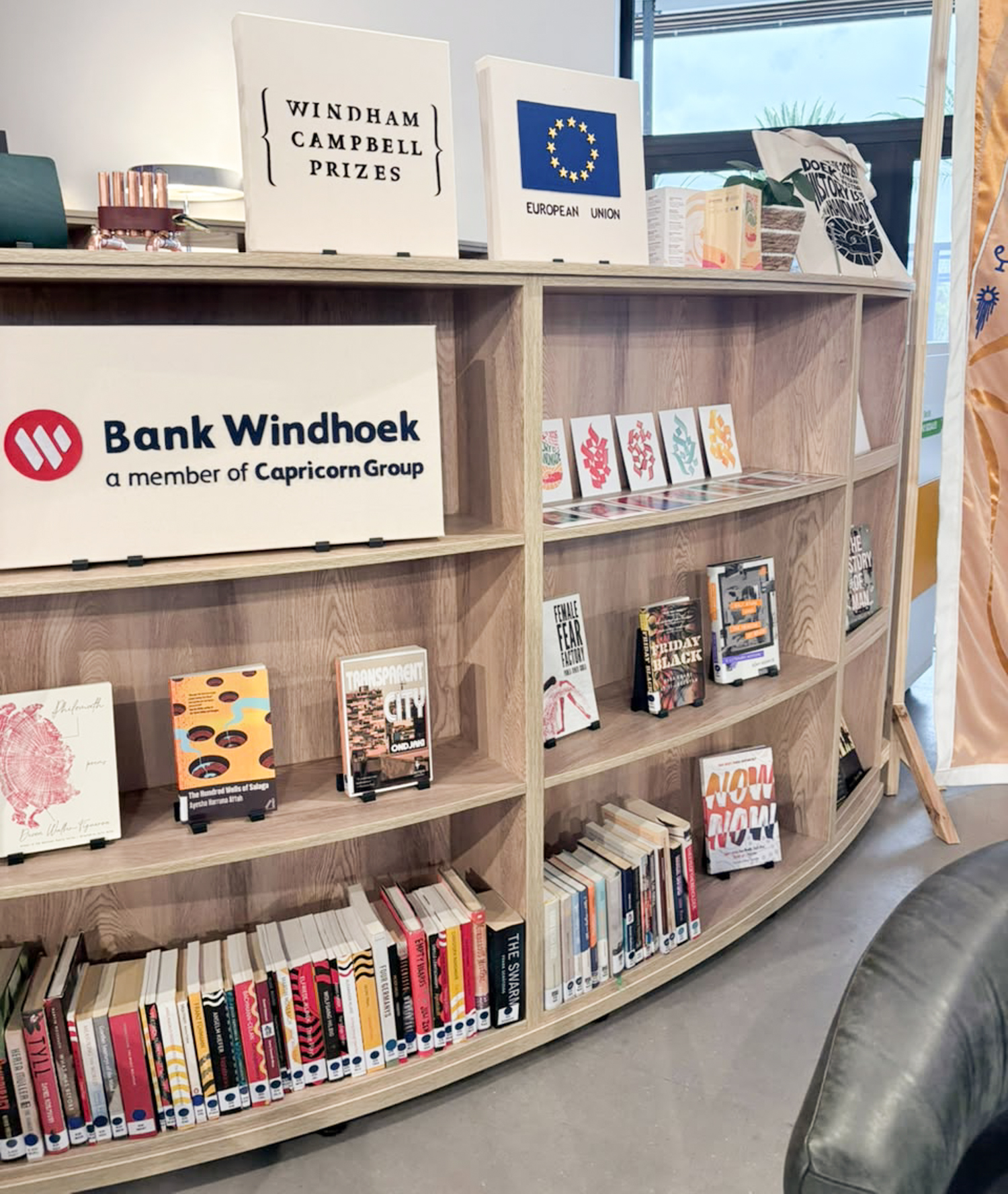
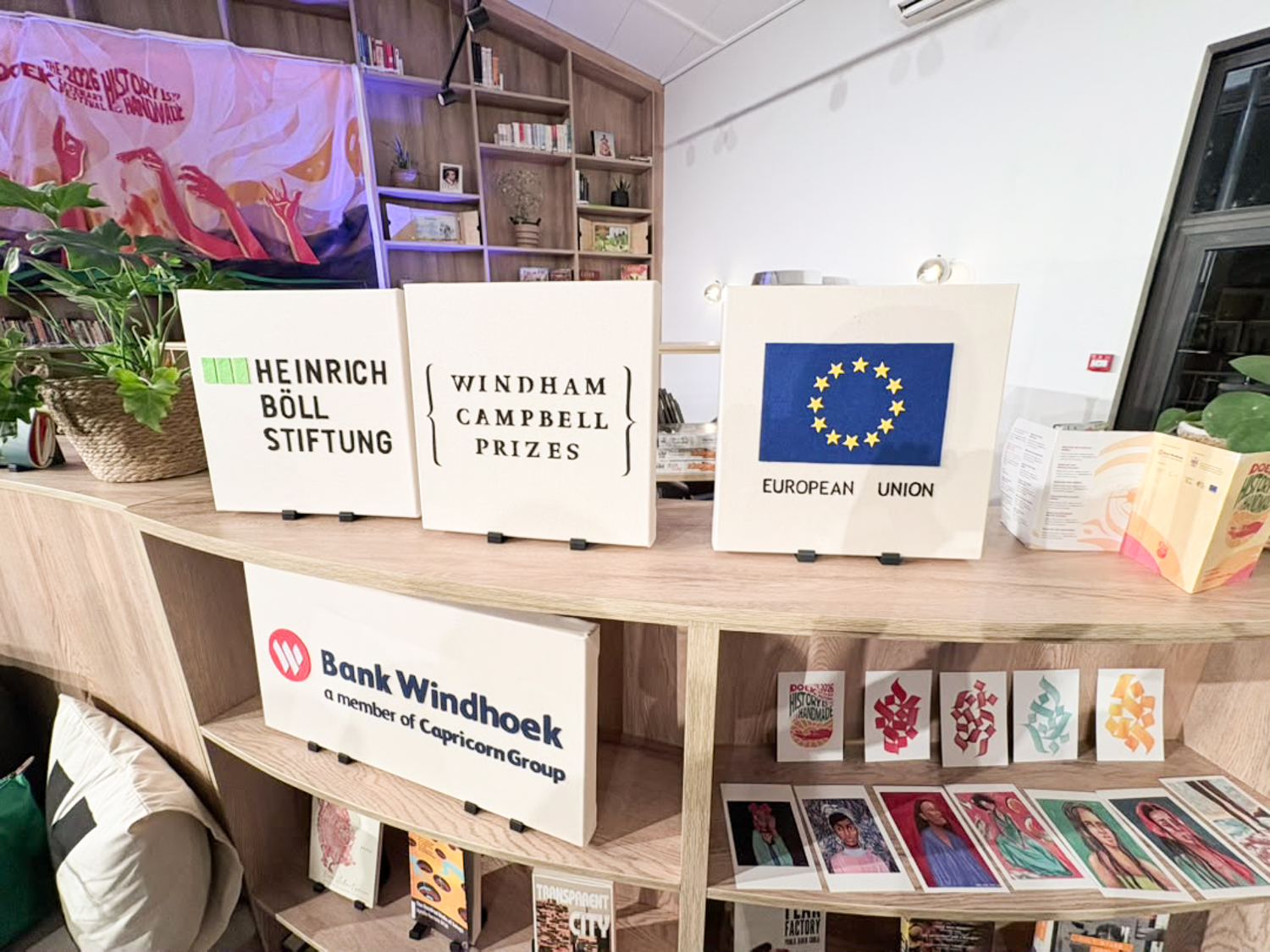
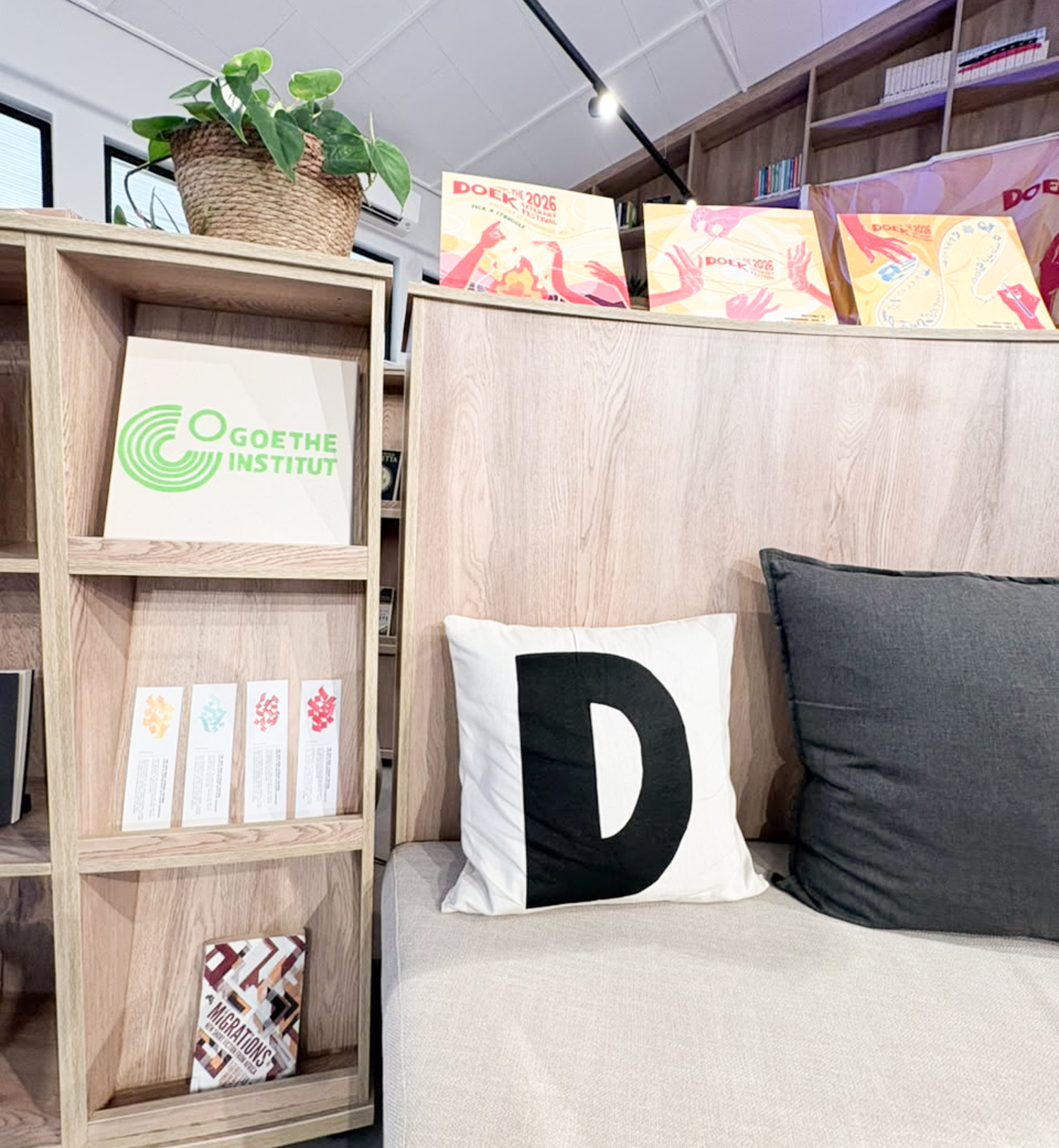
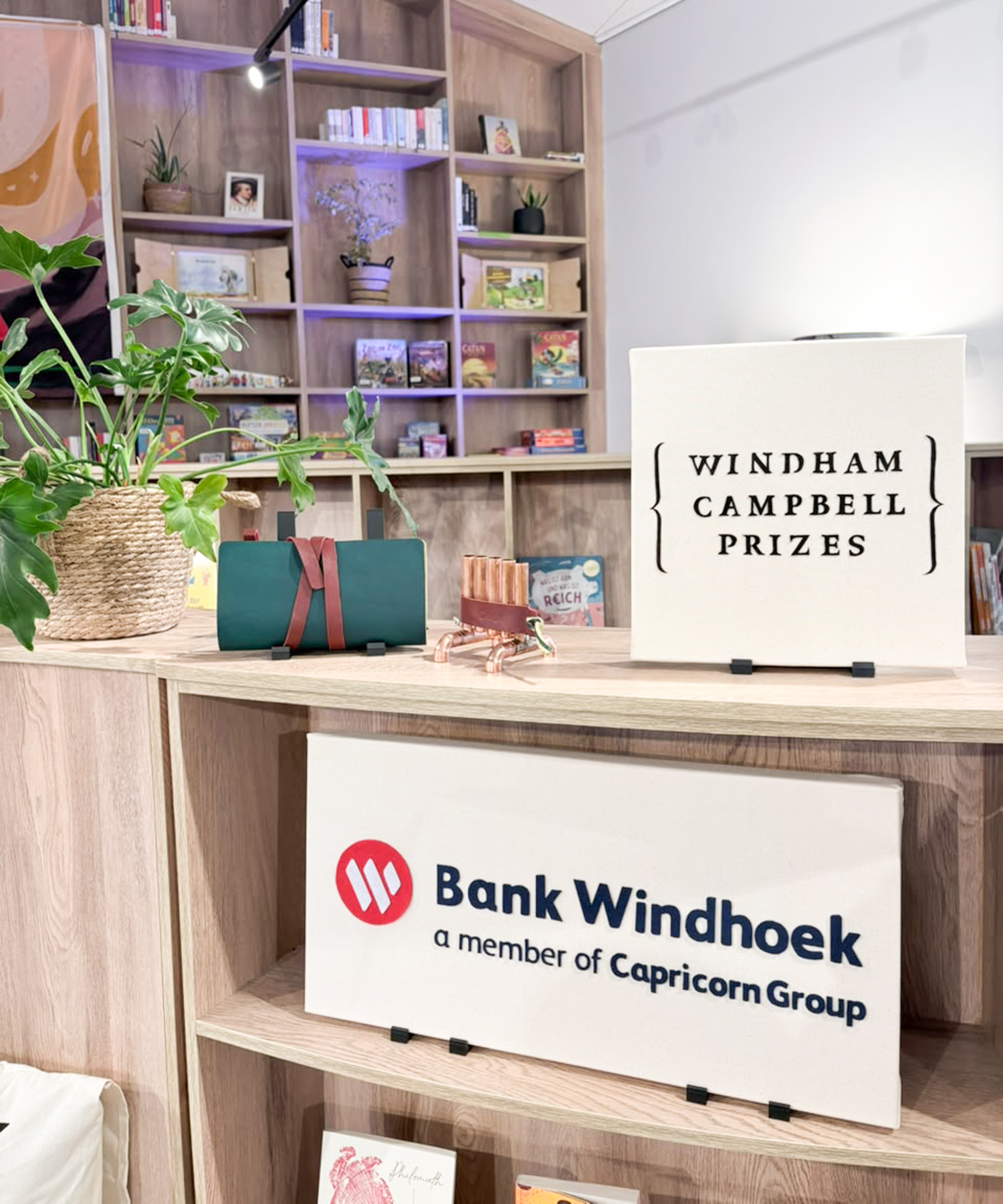
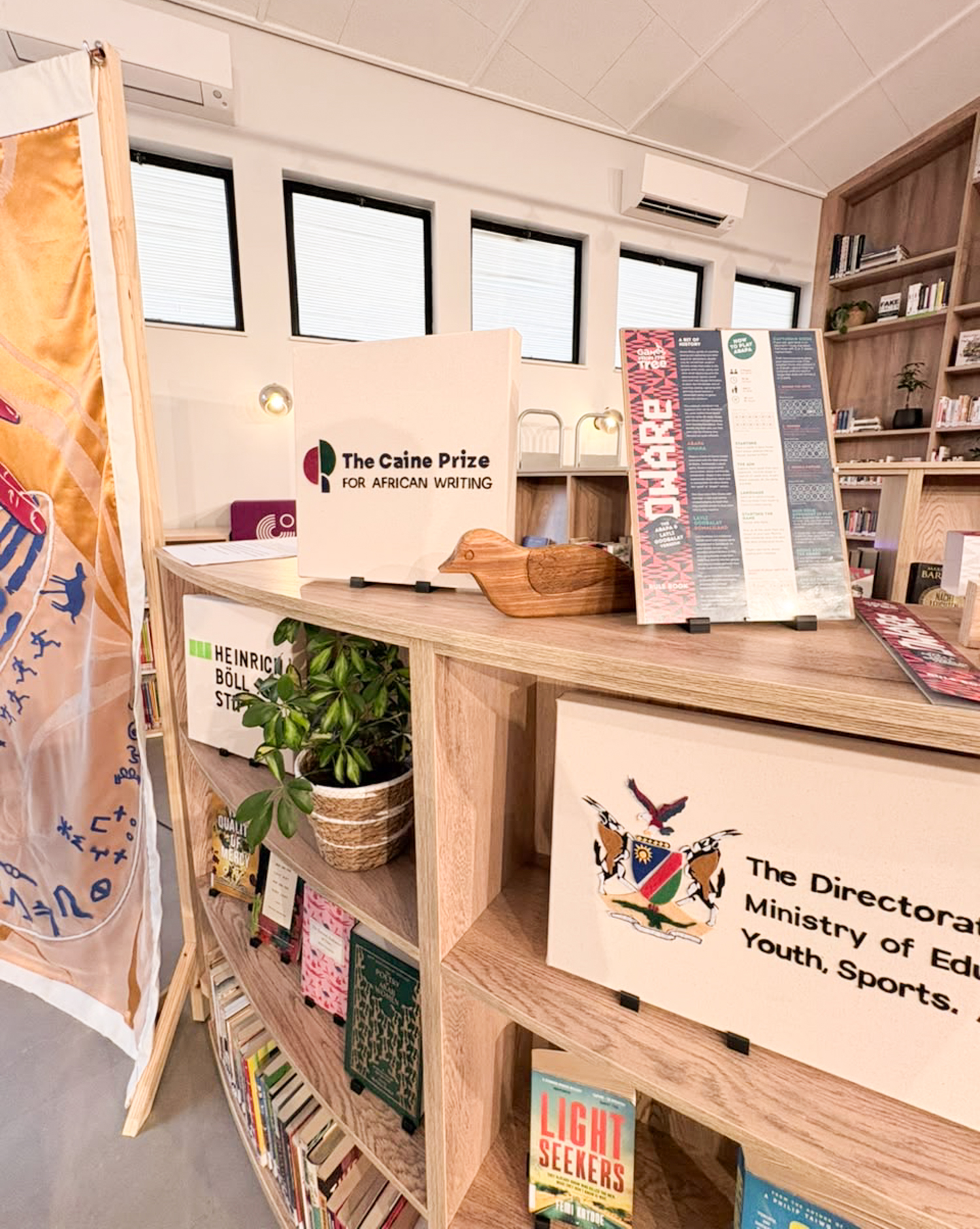


Instead of banner advertising, which often presents disharmonious aesthetics, the Turipamwe team rendered the main festival sponsor logos into hand-cut felt letters assembled on stretched canvas. These presented the design team with quiet but arresting pieces of partner advertising that presented interesting layout opportunities for the Goethe-Institut’s auditorium.
PLAYLISTS
DJ MUSKETEER’S “THEY ARE MEETING AGAIN AT HOME” VINYL SELECTION SET
“Lavender” by Apollo Brown and Bronze Nazareth featuring Love Jones from Funeral For A Dream (2025) • “Maya” by Rapsody featuring K. Roosevelt from Eve (2019) • “Jupiter’s Love” by Black Vulcanite from Black Colonialists (2016) • “Too Much Of A Good Thing” by Apollo Brown and Ras Kass featuring Larina from Blasphemy (2014) • “Come Back Home” by Apollo Brown and Joell Ortiz from Mona Lisa (2018) • “Long Drive Home” by Apollo Brown and Ugly Heroes from Ugly Heroes (2013) • “Purple” by Marv Won from I’m Fine, Thanks For Asking (2024) • “The Knowing” by Skyzoo featuring Jessy Wilson from A Dream Deferred (2012) • “Kreise Schliessen Sich” by AzudemSK (2017) • “She Knowz What She Wantz” by Gang Starr from Moment Of Truth (1998) • “Brown Skin Lady” by Black Star from Mos Def & Talib Kweli Are Black Star (1998) • “Show Me” by Joey Bada$$ from 2000 (2022) • “Paris, Tokyo” by Lupe Fiasco from Lupe Fiasco’s The Cool (2007) • “Slow It Down” by Little Brother featuring Darien Brockington from The Minstrel Show (2005) • “Lots Of Lovin’” by Pete Rock and C. L. Smooth from Mecca And The Soul Brother (1992) • “Travellin’ Man” by DJ Honda featuring Mos Def from Travellin’ Man (2009) • “Alien Girl (Today With Her)” by Kendrick Lamar from Overly Dedicated (2010) • “The Light” by Common from Like Water For Chocolate (2000) • “Reunion” by Slum Village featuring J. Dilla from Detroit Deli (A State Of Detroit) (2004) • and “No Regrets” by Aesop Rock from Labor Days (2001).
LE ROUX VAN SCHALKWYK “LOVE IS APPROACHING” VINYL SELECTION SET
“Dreams” by Fleetwood Mac from Rumours (1977) • “Mother Of Pearl” by Roxy Music from Stranded (1973) • “Plastic Man” by The Temptations from Masterpiece (1973) • “Good Rockin’ Mama” by John Lee Hooker from Sings The Blues (1962) • “World In A Jug” by Canned Heat from Boogie With Canned Heat (1968) • “Spoonful” by The Paul Butterfield Blues Band from Golden Butter (1964) • “Satisfaction Guaranteed” by Rare Earth from Ecology (1970) • “Love Is Like An Itching In My Heart” by Diana Ross & The Supremes from The Supremes A’ Go-Go (1966) • “Let’s Dance” by David Bowie from Let’s Dance (1983) • “Nineteen Hundred And Eighty Five” by Paul McCartney and Wings from Band On The Run (1973) • “Misty Mountain Hop” by Led Zeppelin from Led Zeppelin IV (1971) • and “California Waiting” by Kings Of Leon from Youth And Young Manhood (2003).
BROTHER MBANGO’S “HOPE AND OPTIMISM” VINYL SELECTION SET

“Chapita” by Dick Khoza from Chapita (1976) • “Lumumba 2” by The Movers from Lumumba No. 2 (1975) • “Afro Temple” by Sabu Martinez from Afro Temple (1973) • “Congoman” by The Congos from Heart Of The Congos (1977) • “Languta” by Hugh Masekela from Introducing Hedzoleh Soundz (1973) • “Toi Toi” by Batsumi from Batsumi (1974) • “Synchro System” by King Sunny Ade from Synchro System (1983) • “Ayeo” by Assagai from Assagai (1971) • “Noble Tree” by Fanga & Maâlem Abdallah Guinéa from Fangnawa Experience (2012) • “Fatimita” by Urbano De Castro from Angola Soundtrack 2 (2013) • “My Lady Frustration” by Fela Kuti & Nigeria 70 from The ’69 Los Angeles Sessions (1969) • “Malukayi” by Mbongwana Star from From Kinshasa (2015) • “Tanza” by Nicola Cruz from Cantos De Vision (2017) • “Obi Agye Me Dofo” by Vis-A-Vis from Obi Agye Me Dofo (1977) • and “Pata Pata” by Miriam Makeba from Pata Pata (1967).
QUERIDA’S LIVE SET

“Hypothetical” by Lake Street Dive from Obviously (2021) • “It Runs Through Me” by Tom Misch featuring De La Soul from Geography (2018) • “How Does It Feel” by Hillari (2026) • “So Easy (To Fall In Love)” by Olivia Dean from The Art Of Loving (2025) • “Sweet And Sour” by Elli Ingram from Love Your Really (2017) • “There I Go” by Lucy Park (2025) • “Why Why Why Why Why” by Sault from 5 (2019) • “Old Skool Funk” by Matt Johnson from Warrior Princess (2025) • “Body Language” by Ezra Collective featuring Sarah Keable (2025) • “Badja Tina” by Fattú Djakité (2025).
HOSPITALITY
CULINARY CURATION
The 2026 Doek Literary Festival’s culinary partner—The Munchkins—curated a food experience that provided the festival guests with a homemade, nutritious, all-vegetarian and vegan menu.
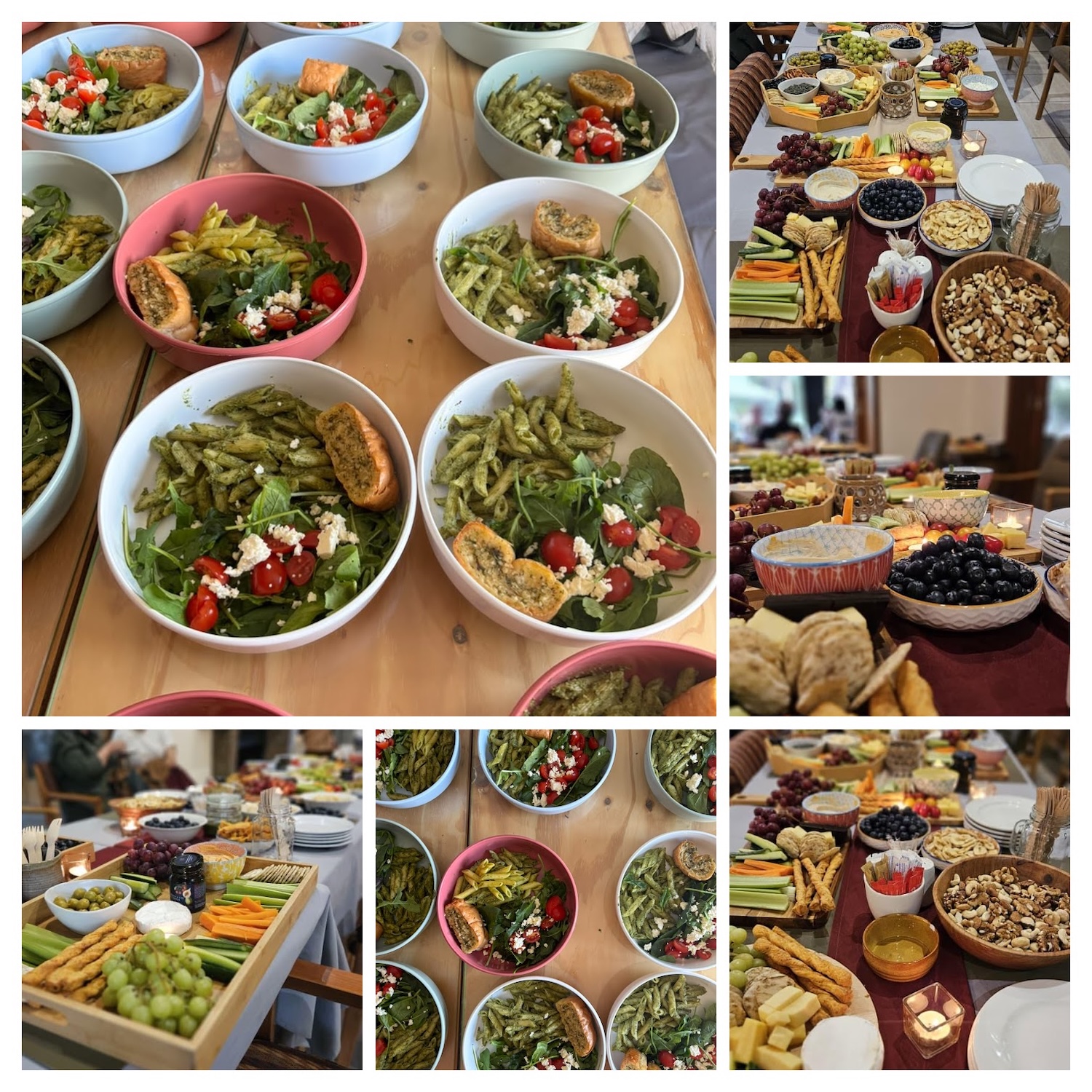
40 meals were freshly prepared each day and delivered to the festival accommodation venue where they were enjoyed in a communal manner that prompted conversation and new connections.
Tuesday, 29 September
- Dinner: roasted vegetable & chickpea couscous bowl with feta and olives, finished with an herb green dressing and served with oshikandela.
Wednesday, 30 September
- Lunch: sticky ginger and garlic wrap with savoury soy strips served with rainbow coleslaw and a spicy mayo dressing.
- Dinner: sun-dried tomato and grilled pepper pasta served with a rocket, feta and tomato salad, served with garlic bread.
Thursday, 01 October
- Lunch: Mediterranean falafel bowl with lemon herb quinoa, hummus and feta salad, and finished with a coriander, lemon, and olive oil dressing.
- Dinner: black bean and chakalaka rice bowl with roasted corn, avocado, and cheddar finished with a creamy avocado dressing and homemade tortilla chips.
Friday, 02 October
- Lunch: sticky ginger and garlic wrap with savoury soy strips served with rainbow coleslaw and a spicy mayo dressing.
- Dinner: coriander pesto pasta served with a rocket, tomato, feta salad, and garlic bread.
Saturday, 03 October
- Closing dinner: curated vegetarian grazing boards featuring a selection of cheeses, hummus, plum and onion marmalade, tomato chilli cheese topper, fresh seasonal produce, crackers, nuts and dried fruits.
FESTIVAL EXCURSIONS
Excursions to the Namibian Arts Association, the Namibian Independence Museum, the National Art Gallery of Namibia, Uncle Spike’s Book Exchange, the Namibian Craft Centre, and “The Window On The West” (corner of Pasteur and Florence Nightingale Street) facilitated the immersion in Windhoek’s cityscape and fostered an appreciation for the city’s history, its present challenges, and its future ambitions.
WHAT WAS LEARNED ALONG THE WAY